The wellness and health sector offers founders a massive opportunity to build impactful brands. As consumers become more proactive about their health, the demand for targeted products like vitamins, proteins, and specialty ingredients continues to rise.
In fact, the global dietary supplements market is projected to grow from USD 93.46 billion in 2024 to USD 182.52 billion by 2032, demonstrating a CAGR of 8.73% during that period.
However, entering this highly regulated industry presents significant hurdles. The successful launch of a nutrition supplement business hinges not just on a great idea, but on flawless execution and a trustworthy production partner.
In this article, we break down the necessary steps into a practical 8-point framework designed to guide founders from concept to market-ready product, setting up your nutrition supplement business for long-term growth and compliance.
Key Takeaways
Niche selection is your most critical strategic decision. Targeting a specific demographic and health concern is more effective than competing in broad, saturated markets.
Regulatory compliance is non-negotiable and complex. Partnering with an FDA-registered, cGMP-compliant manufacturer is the most reliable way to mitigate legal and reputational risk.
A turnkey contract manufacturer eliminates major startup barriers. This model provides access to expert R&D and quality-controlled production without the capital expenditure of a private facility.
Inconsistent quality and production delays are preventable. These common failures are directly addressed by choosing a partner with automated systems and single-source accountability.
Your business plan must be built around real manufacturing costs. Accurate financial projections for product development, testing, and production MOQs are essential for securing funding and managing cash flow.
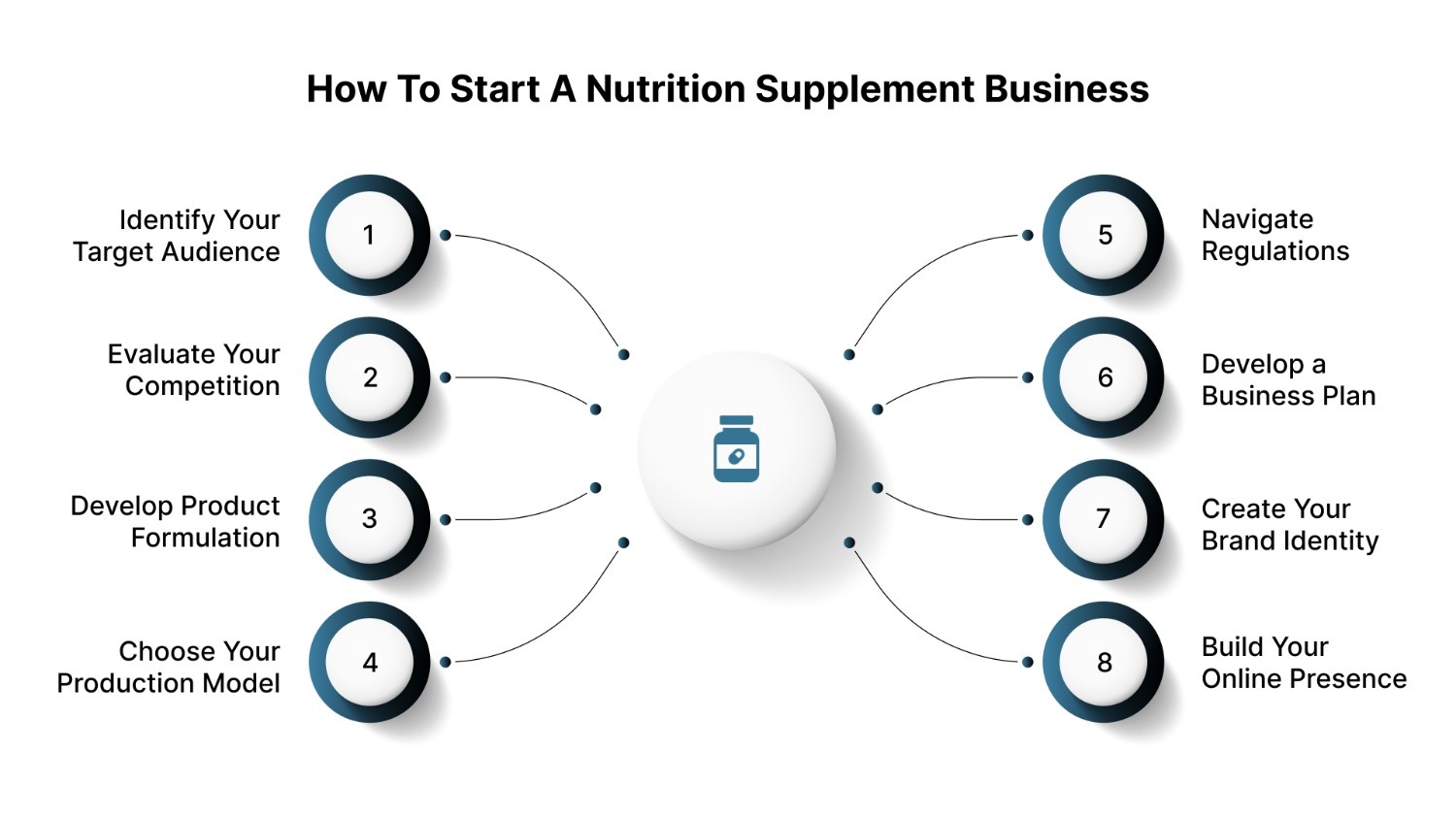
How To Start A Nutrition Supplement Business In 8 Steps
Launching a new supplement line involves more than mixing ingredients and designing a label. It needs a strategic approach for product development, legal compliance, and manufacturing. Here are the eight essential steps to guide your journey:
Step 1: Identify Your Target Audience And Niche
Before investing in formulation, you must define precisely who your customer is and what specific health problem you solve. A vague target like "health-conscious adults" makes marketing difficult and product development unfocused.
Action Steps:
Define Demographics: Are you targeting younger, active adults or the geriatric population concerned with bone health?
Identify a Specific Pain Point: Do you address stress relief, gut health, or performance for endurance runners? For example, focusing on a "clean, high-protein powder for vegans with sensitive stomachs" is a strong niche.
Check Market Demand: Use market research tools to confirm that the problem you are solving has a quantifiable market size and genuine consumer interest.
Below is a nutrition supplement business niche evaluation framework:
Niche Category | Target Demographic | Sample Products | Competition Level | Growth Potential |
Sports Nutrition | Athletes, gym members | Protein powders, pre-workout, BCAAs | High | Steady |
Age-Specific | Seniors, millennials | Joint support, cognitive health | Medium | High |
Condition-Specific | Sleep, digestion issues | Melatonin, probiotics | Medium | Growing |
Lifestyle | Vegans, clean label users | Plant-based proteins, organic | Low | Rapid |
Step 2: Evaluate Your Competition
Understanding your competitive landscape helps you position your brand effectively. Research both direct competitors (other supplement brands) and indirect competitors (whole food alternatives or lifestyle solutions).
Key Analysis Areas Include:
Product formulations and ingredient quality
Pricing strategies and package options
Brand messaging and customer engagement
Distribution channels and retail partnerships
Customer reviews and complaint patterns
Tools for In-Depth Competitor Research:
To properly size up your competition, move beyond simple Google searches. Use the following:
Amazon/Etsy: Analyze the top 100 sellers in your niche (e.g., "collagen powder for women") to identify successful product bundles, review counts, and effective pricing tiers.
Social Listening (e.g., Reddit, Quora): Search for discussions where customers complain about existing products. These complaints reveal crucial product gaps or unmet needs that your brand can specifically address.
SEO Tools (e.g., Ahrefs, SEMrush): Analyze which keywords your competitors rank for and what content is driving their traffic. This helps you plan your own content and marketing strategy.
Identify what makes successful competitors stand out and look for opportunities to differentiate through superior ingredients, more transparent sourcing, or more engaging brand storytelling.
Step 3: Develop Your Product Formulation
Your product formulation transforms your business concept into a tangible offering. Key considerations include:
Ingredient selection: Choose evidence-based ingredients with proven benefits.
Bioavailability: Ensure nutrients are in forms your body can effectively use.
Delivery format: Decide between capsules, tablets, powders, or gummies.
Dosage accuracy: Establish precise measurements for consistent results.
Consider these formulation options and requirements:
Formulation Aspect | Options Available | Cost Impact | Time to Market |
Delivery Format | Capsules, tablets, powders, gummies | Low to High | 2-6 months |
Ingredient Quality | Standard vs. clinically proven | Significant | Similar |
Certifications | Organic, non-GMO, vegan | Moderate | Additional time |
Dosage Strategy | Single ingredient vs. complex blends | Varies | Similar |
Start with a focused product range rather than numerous SKUs. This ensures quality control, simplifies inventory management, and allows for more targeted marketing as you establish your brand.
Struggling to align your formulation with FDA regulations and market demand? Contact Respect Manufacturing’s formulation consultation and R&D experts to de-risk your product development.
Step 4: Choose Your Production Model
Selecting the right production approach significantly impacts your startup costs and operational complexity. Consider these options:
Private labeling: Using existing formulations with your branding.
Contract manufacturing: Partnering with experts for custom formulation and production.
In-house production: Establishing your own manufacturing facility.
For most emerging brands, contract manufacturing provides the ideal balance of custom formulation capabilities without the massive capital investment required for in-house production.
This model offers access to expert formulators, established quality control systems, and scalable production capacity.
Step 5: Navigate Regulations and Compliance
Regulatory compliance forms the foundation of a legitimate supplement business. Key requirements include:
Facility compliance: Manufacturing must occur in an FDA-registered facility that follows Current Good Manufacturing Practices (cGMP).
Labeling accuracy: Ensure proper ingredient listing and avoid making unapproved health claims.
Documentation: Maintain detailed records of formulations, manufacturing processes, and quality control measures.
Third-party testing: Consider independent verification of ingredient purity and product potency.
Understanding that cGMP represents the quality standards enforced by the FDA is crucial for compliance.
Step 6: Develop a Business Plan
A detailed business plan serves as your roadmap to success and is essential for securing financing. Your plan should include:
Startup cost analysis: Account for product development, initial production runs, marketing, and operational expenses.
Market analysis: Define your target audience, competitive landscape, and market positioning.
Sales strategy: Outline specific channels, ecommerce, retail partnerships, and practitioner recommendations.
Financial projections: Develop realistic revenue forecasts, expense budgets, and cash flow projections.
Growth milestones: Set specific, measurable goals for your first 1-3 years of operation.
Step 7: Create Your Brand Identity and Packaging
Your brand identity distills your company's values and market position into visual and verbal elements that resonate with your target audience. Key components include:
Brand story: Develop a compelling narrative that connects with consumers emotionally.
Visual identity: Create a consistent logo, color scheme, and typography that reflects your positioning.
Packaging design: Balance compliance requirements with aesthetic appeal and functionality.
Sustainability considerations: Evaluate eco-friendly packaging options to appeal to environmentally conscious consumers.
Consider these packaging options:
Packaging Type | Cost Level | Consumer Appeal | Best For |
Delivery Format | Low | Standard | Powders, capsules |
Glass Jars | Medium | Premium | Premium products |
Stick Packs | Medium | Convenience | Single-serve powders |
Sachets | Low to Medium | Sample/travel | Samples, single-use |
Sustainable Options | High | Growing appeal | Eco-conscious brands |
Step 8: Build Your Online Presence and Sales Channels
Modern supplement brands require a strong digital presence. Consider these sales channel options:
Direct-to-consumer ecommerce: Build your own website for maximum brand control and customer relationships.
Marketplace sales: Leverage established platforms like Amazon for immediate access to large customer bases.
Retail partnerships: Place products in brick-and-mortar stores through distributor relationships.
Practitioner channels: Work with health professionals who can recommend your products.
Create informative content that establishes your brand as a credible authority, and implement search engine optimization techniques to boost your visibility.
Moving past the basic launch steps, the difference between stability and failure in the regulated health industry lies in adopting expert-level operational rigor.
Advanced Launch Checklist: Best Practices for Success
While the 8 steps cover the essential roadmap to launching your nutrition supplement business, true scalability and risk mitigation lie in adopting advanced operational and quality control protocols.
This checklist moves beyond the basics, providing a strategic framework to address the complexities of the highly regulated supplement industry:
1. Pre-Launch Best Practices (Before You Start Production)
These practices address the foundational strategy and de-risking phase.
Deepen Your Competitive Analysis to Find Your USP:
Do not just identify competitors; analyze their customer reviews. Use marketplaces like Amazon to find recurring complaints about top-selling products in your niche (e.g., "bad taste," "stomach upset," "incomplete dosage"). These complaints are your immediate market gaps and the core of your Unique Selling Proposition (USP).
Action: Define your USP as the single reason a customer should choose you over anyone else (e.g., "The only CGMP-certified fish oil that guarantees no aftertaste").
Financial Best Practice: Accurately Calculate COGS for Retail Readiness:
Successful brands budget for a sufficient margin to enter retail or scale paid advertising. Calculate your Cost of Goods Sold (COGS) (raw materials, packaging, labor, freight) and ensure your final COGS is no more than 20-25% of your Suggested Retail Price (SRP).
Action: Create pricing for Direct-to-Consumer (D2C) only. If you want to expand to wholesale or retail, you must build margin for distributor and retailer markups (typically a 50% discount off SRP).
Legal Best Practice: Pre-Vet All Claims:
Compliance starts before printing. Do not wait for the manufacturer to flag issues. Work with a legal or regulatory expert to pre-vet your product name, all website copy, and marketing language. You must only use approved "structure/function" claims (e.g., "supports immune function"), not disease claims (e.g., "cures the cold").
2. Production & Quality Best Practices (During Manufacturing)
These practices focus on mitigating quality and compliance risk (core concerns of the ICP).
Demand Full Batch Traceability:
A reliable manufacturer must provide a detailed Batch Record for every production run. This document is the legal history of your product, proving the origin of every ingredient, the exact processing steps taken, and all quality control tests performed.
Action: Insist on full traceability from raw material supplier to finished goods.
Mandate AQL Testing on All Components:
Prevent major line shutdowns and product recalls by ensuring your packaging is flawless. Acceptance Quality Limit (AQL) testing must be performed on all incoming components (bottles, caps, seals, labels) before the manufacturing run. This confirms the packaging will work correctly on the automated lines and prevent leaks or defects.
Plan for Shelf Life (Stability Testing):
Do not launch without stability data. Stability testing ensures your product retains its potency and stated claims throughout its entire shelf life (typically 18-24 months). A compliant partner will incorporate this into the R&D phase to prevent formula degradation after launch.
3. Post-Launch Best Practices (After the Product Hits the Market)
These practices focus on customer retention and long-term brand building.
Focus on Customer Lifetime Value (CLV):
It costs significantly more to acquire a new customer than to retain an old one. Build subscription models and loyalty programs into your D2C platform immediately.
Action: After the first purchase, focus on creating content and email campaigns that educate the customer on product usage and highlight complementary SKUs.
Build Trust Through Transparency and Certifications:
Leverage your manufacturing transparency. Highlight the fact that your product is made in an FDA-registered, CGMP-certified facility. Use certifications (e.g., Organic, Non-GMO) as trust signals on your packaging and website. The modern consumer demands to know where their supplements come from.
Establish a Feedback Loop for R&D:
Your product is never truly finished. Systematically collect customer feedback, especially negative reviews. Use this data to refine your formulation, improve your delivery format, or inform your next product extension, constantly maintaining an edge over competitors.
Adhering to those advanced best practices helps you preempt failure. However, every scaling brand inevitably faces three core operational hurdles that threaten quality and speed.
Common Challenges And How To Avoid Them
Even with a well-defined plan, brands scaling in the nutrition supplement business face predictable obstacles.
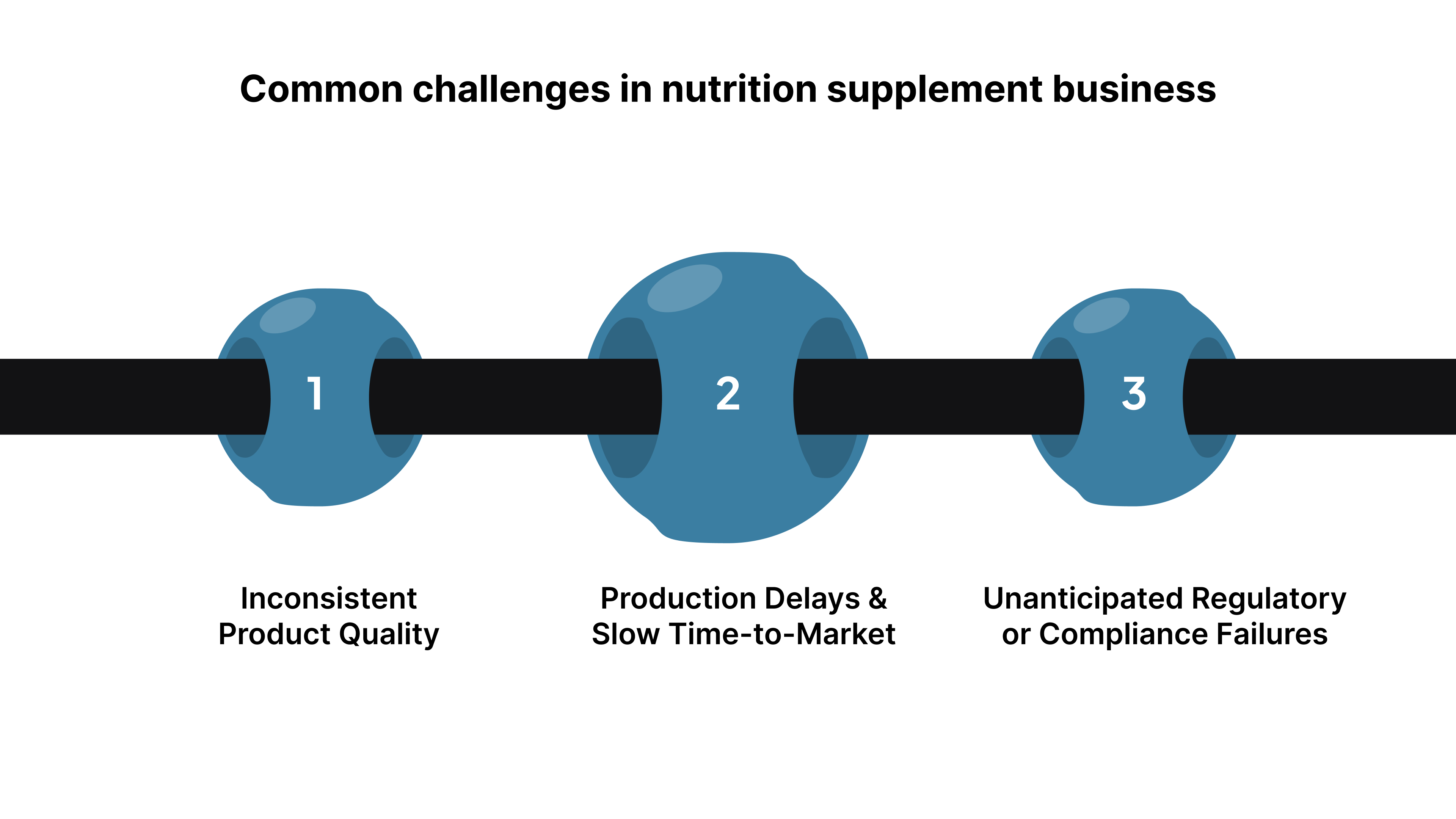
Inconsistent Product Quality
A common risk when switching manufacturers or working with partners who rely on outdated equipment is batch-to-batch variation in quality and potency.
Solution: Only partner with CGMP-compliant manufacturers that use modern, automated systems and implement comprehensive, documented testing protocols for raw materials and finished goods.
Tired of juggling multiple vendors? Discover how our single-source, turnkey solution can simplify your supply chain and cut your time-to-market significantly.
Production Delays and Slow Time-to-Market
Juggling separate vendors for R&D, packaging, manufacturing, and logistics inevitably leads to communication delays and scheduling conflicts.
Solution: Consolidate your supply chain by choosing a single-source, turnkey partner. This simplifies coordination and guarantees clear accountability from concept to finished product.
Unanticipated Regulatory or Compliance Failures
Non-compliant labeling or poor documentation can result in product recalls, fines, and severe brand damage.
Solution: Work exclusively with an FDA-registered facility that has dedicated Quality and Regulatory Managers focused on compliance assurance and thorough documentation at every stage of production.
What if you could sidestep these challenges altogether? The most effective strategy is to partner with a manufacturer designed to prevent them from the start.
How Respect Manufacturing Supports Your Supplement Business
Launching a nutrition supplement business presents significant challenges, including regulatory complexity, quality control concerns, and the substantial capital investment required for manufacturing capabilities. These obstacles prevent many promising brands from successfully reaching the market.
Respect Manufacturing eliminates these barriers by serving as your end-to-end partner for supplement manufacturing. Our turnkey solutions transform your product concept into market-ready supplements while ensuring strict compliance, consistent quality, and faster time-to-market.
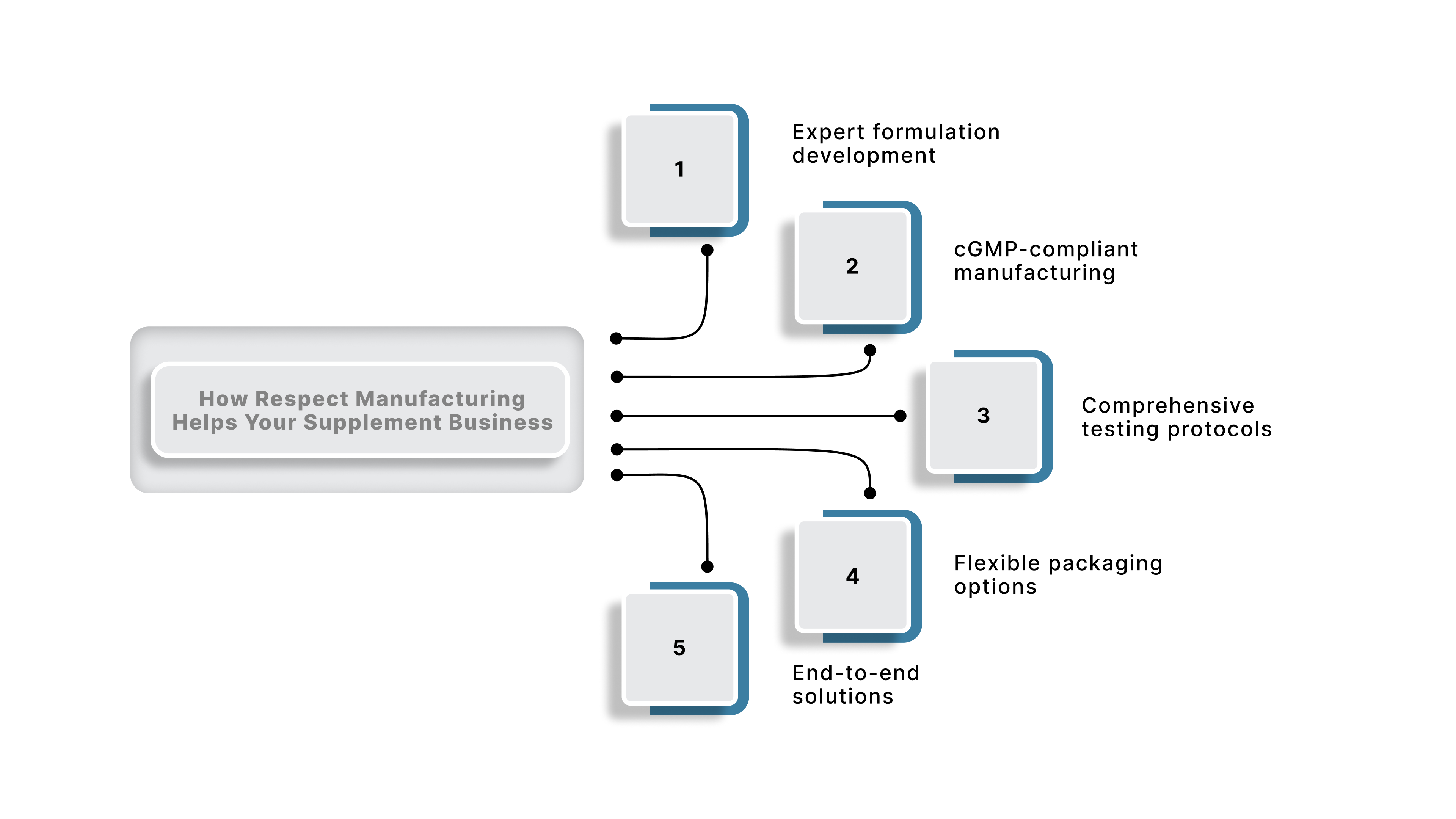
Our comprehensive services include:
Expert formulation development: Our R&D team works alongside you to create or enhance formulations that comply with regulatory standards and align with market demands.
cGMP-compliant manufacturing: All products are manufactured in our FDA-registered facility using automated production lines and strict quality controls
Comprehensive testing protocols: We conduct thorough testing on incoming materials and finished goods to ensure product safety and efficacy
Flexible packaging options: Our facility supports various packaging formats with complete secondary packaging capabilities
End-to-end solutions: We manage every stage from concept to finished goods, including stability testing, manufacturing, and quality compliance
By consolidating these capabilities with a single partner, we reduce your operational complexity while ensuring the quality and compliance your brand requires.
Conclusion
Successfully launching a nutrition supplement business requires careful planning, strategic formulation, and, most importantly, a solid commitment to quality and compliance.
By following these eight steps, from niche identification to building your sales channels, you create a defensible foundation for growth. The most crucial decision, however, remains the choice of your production partner.
To rapidly accelerate your growth and mitigate the inherent risks of scaling production, partnering with an experienced, compliant contract manufacturer is the clearest path. Respect Manufacturing’s vision is to empower wellness brands by providing guaranteed quality, transparency, and consistency at every stage of the production lifecycle.
If inconsistent quality, compliance fears, or multi-vendor delays are holding your brand back from its next stage of growth, it is time to choose a reliable, turnkey partner.
Contact Respect Manufacturing today to schedule a consultation and discover how our CGMP-certified, end-to-end solutions can turn your scaling challenges into market dominance.
FAQs
Q. What are the startup costs for a supplement business?
Startup costs vary based on your production model and scale. While establishing your own manufacturing facility requires substantial investment, partnering with a contract manufacturer significantly reduces upfront costs.
Typical expenses include business registration, product development, initial production runs, brand development, and marketing.
Q. How long does it take to get a supplement product to market?
The timeline from concept to market typically ranges from 3-6 months, depending on formulation complexity and regulatory requirements. The process includes product development, stability testing, packaging design, initial production runs, and quality assurance checks.
Q. Do I need FDA approval to sell supplements?
The FDA usually does not approve dietary supplements before they reach consumers, but manufacturers must ensure product safety and compliance with labeling requirements. Supplement companies must manufacture in FDA-registered facilities that follow Current Good Manufacturing Practices (cGMP).
While pre-market approval isn't required, the FDA monitors product safety and can take action against unsafe products.
Q. What is the minimum order quantity for a new supplement brand?
Minimum order quantities (MOQs) vary by manufacturer but are a critical factor for new brands. Typical MOQs range from 5,000 to 50,000 units per product, influenced by the packaging format and ingredient complexity.
Respect Manufacturing works with emerging brands to determine cost-effective production runs that align with their business stage and market demand, offering flexibility for initial launches.
Q. Can I create a completely custom supplement formula, or am I limited to existing options?
Yes, you can develop a fully custom formula. Reputable contract manufacturers like Respect Manufacturing offer both custom formulation development and private labeling of existing products.
The custom formulation process involves collaborative work between your team and the manufacturer's R&D experts to product that meets your vision, target market needs, and regulatory requirements.