The demand for supplements across categories such as wellness, nutrition, and personal care continues to rise.
According to Precedence Research, the global dietary supplements segment alone is valued at USD 203.42 billion in 2025 and is expected to reach USD 375.12 billion by 2033.
This level of growth is pushing more brands to explore selling supplements online.
The opportunity is strong, but the operational work behind a compliant product is often underestimated. Teams must manage FDA rules, cGMP manufacturing standards, accurate labels, ingredient sourcing, packaging timelines, and required documentation. Most delays occur when these steps are not planned early.
In this article, we’ll cover the fundamentals you should know before selling supplements online so your production stays consistent and compliant.
Key Takeaways:
Selling supplements online requires strict regulatory compliance and documentation, not just listing a product.
Operational decisions around format, ingredients, and packaging shape your testing needs, lead times, and manufacturing complexity.
Marketplace approvals depend on accurate labeling, proper testing, and organized CGMP documentation.
A predictable supply chain is essential for consistent batches, stable inventory, and steady production cycles.
Scaling your SKU count should be driven by operational readiness, not demand alone.
Why Selling Supplements Online Is Not as Simple as Listing a Product
Selling supplements online seems simple, but the operational reality is far more complex. Supplements are regulated products, and growth depends on compliance and consistency, not marketing alone.
Key challenges brands face:
Supplements must meet FDA and CGMP expectations, which go beyond typical eCommerce requirements.
Batch consistency, ingredient sourcing, and documentation need continuous oversight.
Label accuracy, allergen statements, and Supplement Facts panels must be correct every time.
Stability, potency, and microbial testing add ongoing operational work.
Any gap in compliance can trigger Amazon delistings, chargebacks, failed retailer onboarding, or payment holds.
For scaling brands, these challenges determine whether you grow sustainably or face avoidable setbacks.
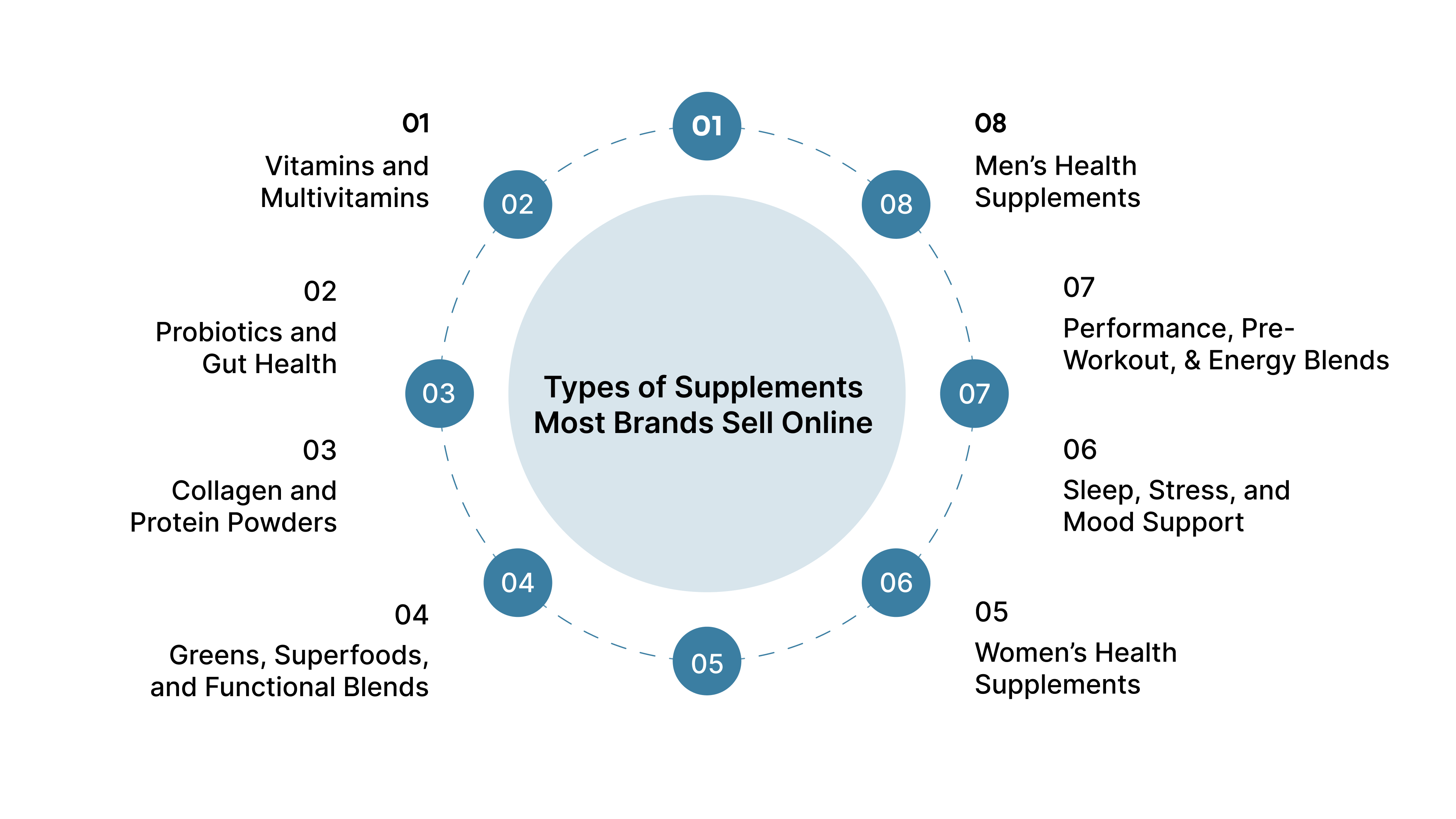
8 Types of Supplements Most Brands Sell Online
Before building out your product line, it helps to understand the supplement categories that are commonly launched online and the operational considerations that come with each one. Here are the most commonly sold online supplements:
1. Vitamins and Multivitamins
A straightforward category from a production standpoint. Formulas typically use well-established ingredients, which helps with sourcing and predictable batch planning.
Operational Considerations:
Potency and identity testing
Label accuracy for daily values and units
Predictable MOQs for steady replenishment
2. Probiotics and Gut Health
These require tighter control because they contain live organisms. Stability, proper storage, and packaging choices have a direct impact on product quality.
Operational Considerations:
Strain verification
Stability data for CFU count
Packaging that protects live organisms
3. Collagen and Protein Powders
Often produced in larger volumes with bulk ingredients. These products focus heavily on blending consistency, flavor development, and packaging durability.
Operational Considerations:
Ingredient price volatility
Heavy-duty packaging and freight planning
Consistent flavor and mixability across batches
4. Greens, Superfoods, and Functional Blends
Usually, these are multi-ingredient products. This increases the number of checks needed during sourcing and blending. Consistency across batches is a key focus here.
Operational Considerations:
Multi-ingredient identity and purity testing
Allergen and cross-contamination controls
Uniform blending to reduce clumping or separation
Also read: 8 Simple Steps To Start A Nutrition Supplement Business
5. Women’s Health Supplements
Formulations often use specific active ingredients that require precise dosing and careful label development to meet regulatory expectations.
Operational Considerations:
Precise dosing for active ingredients
Claims review for regulatory alignment
Additional scrutiny for hormone-related ingredients
6. Sleep, Stress, and Mood Support
Products in this category typically include recognizable functional ingredients. These require accurate documentation and conservative claims to meet listing requirements.
Operational Considerations:
Careful claims language
Documentation for active ingredients
COAs that match Amazon or Walmart requirements
7. Performance, Pre-Workout, and Energy Blends
These blends rely on stimulants or active compounds that require exact potency control, clear labeling, and consistent flavor across batches.
Operational Considerations:
Accurate potency testing for stimulants
Clear labeling for caffeine and active compounds
Batch consistency for flavor and performance
8. Men’s Health Supplements
Often developed around targeted use cases. These formulations require verified ingredient sourcing and accurate claims language.
Operational Considerations:
Formula stability
Clear differentiation and claims review
Verified raw material sourcing
Understanding these categories early allows you to plan formulations and batches in a way that supports consistent manufacturing.
The 9 Essential Steps to Selling Supplements Online
Use this step-by-step guide to plan your formulation, supply chain, documentation, and launch process with clarity.

Step 1: Know the Regulations Before You Sell Anything
Supplements follow a different regulatory path than standard consumer packaged goods. Getting this wrong early leads to delays during production, packaging, and marketplace approvals.
Before you move forward, here are the foundational areas you need to understand:
FDA dietary supplement regulations, including CGMP requirements
What must appear on your label (Supplement Facts, ingredient order, warnings, allergens)
Claims you must avoid, especially anything implying prevention, treatment, or cure
Testing requirements such as identity, purity, microbial, heavy metals, and potency checks
What to do:
Read the FDA’s Dietary Supplement CGMP overview
Identify who will own compliance within your team
Prepare a simple folder structure for documentation (COAs, specs, label files)
List any functional claims you want to make and review them for regulatory alignment
Step 2: Define Your Product Scope (Format, Ingredients, Category)
Your product scope determines how the product is made, how long it takes to produce, what it costs, and the documentation required.
Key decisions to finalize early:
Area | What You Need to Decide | Why It Matters |
Format | Capsules, powders, gummies, liquids | Each format has different production, testing, and equipment needs. |
Ingredients | Number of active ingredients, sourcing reliability, allergen considerations | More ingredients increase documentation and sourcing steps. |
Category | General wellness, gut health, women’s health, performance, etc. | Category affects labeling requirements and testing expectations. |
Packaging | Bottle, tub, pouch, stick pack | Packaging often has the longest lead time and affects freight and fulfillment. |
These decisions shape your manufacturing workflow. Some formats require additional testing, certain ingredients need more documentation, and packaging timelines may influence your launch date. Ingredient availability also affects production schedules, especially during reorders.
What to do:
Choose ingredients with predictable sourcing
Select a format you can support operationally (capsules and powders are often the simplest)
Confirm packaging lead times early
Create a one-page product scope document outlining your format, ingredients, category, and packaging
Step 3: Choose Your Manufacturing Model — Private Label or Custom Formulation
Your manufacturing model affects launch speed, documentation needs, formula flexibility, and long-term scalability. To make the right choice, it helps to compare both options side by side.
Factor | Private Label | Custom Formulation |
Launch Speed | Faster because formulas already exist | Longer due to formulation and testing steps |
Upfront Cost | Lower | Higher |
Formula Flexibility | Limited to existing formulas | Full control over ingredients and dosages |
Documentation Needs | Standard testing and COAs | Additional development and testing records |
Differentiation | Lower | Higher because the formula is unique |
Operational Complexity | Lower | Higher due to development cycles |
Once you compare both paths, choose the model that aligns with your timeline, resources, and product goals. To move forward with a clear decision:
Use a private label if you need a faster launch with fewer development steps
Choose a custom formulation if you need specific ingredients or a unique formula
Ask your manufacturer for sample timelines, MOQs, and testing requirements
Confirm which documents they provide at each stage of development and production
Step 4: Build a Realistic Cost and MOQ Plan
Your cost structure depends on decisions you control (formula, packaging) and external factors such as ingredient availability and MOQ requirements. Mapping these early helps you set realistic margins and production timelines.
Primary cost drivers to consider:
Ingredients: availability, purity, active levels
Packaging: material type, order quantities, customization
Testing: identity, purity, microbial, stability
MOQs: minimum order requirements for materials and finished goods
Freight and storage: shipping method, warehouse needs
Additional costs to account for:
Label or artwork changes
Extra testing if the formula or supplier changes
Packaging adjustments
Storage and fulfillment fees
The next step is to build a cost-of-goods estimate with your manufacturer, confirm packaging MOQs early, budget for additional testing, and clarify freight and storage expectations. This helps you set accurate margins and avoid surprises later in the process.
Step 5: Map Out Your Supply Chain Before You Scale

A predictable supply chain supports consistent production and steady inventory levels. Mapping each part early gives you a clear view of what drives lead times and where delays are most likely to occur.
Major supply chain elements to map:
Ingredients: Supplier reliability, sourcing timelines, allergen or storage considerations
Packaging: Lead times for bottles, tubs, pouches, or cartons; MOQ requirements; artwork approval timelines
Production: Filling capacity, production slot availability, timing for identity, purity, microbial, and potency testing
Freight and Storage: Shipping method, transit time, warehousing conditions
Fulfillment: How inventory is received, stored, picked, packed, and shipped
Once you map these elements, pay close attention to their timelines.
Packaging often has the longest lead time
Ingredient changes may require new testing
Artwork delays can slow the entire production sequence
What to do:
Create a simple end-to-end timeline that covers ingredients, packaging, production, testing, and freight. Identify long-lead items, confirm storage arrangements, and document your reorder process to keep future batches on schedule.
Step 6: Build a Compliance-Ready Label
Your label is a compliance document. It must meet FDA requirements and align with marketplace expectations. Clean, accurate labeling reduces approval delays and supports consistent production across batches.
What your label must include:
A correct and complete Supplement Facts panel
Standardized units of measure
Ingredient order and naming conventions
Allergen disclosures
Required warnings and usage instructions
Facility and origin statements
Batch or lot coding
Serving size and directions for use
Ensuring these elements are correct helps avoid avoidable reprints, approval delays, and additional review cycles.
What to do:
Ask your manufacturer for a label template
Have your regulatory reviewer check the claims language
Ensure the label layout matches the FDA structure
Save label source files for future revisions
Also read: Best Dietary Supplement Makers in the USA
Step 7: Prepare for Marketplace Requirements (Amazon, Walmart, Shopify)
Online marketplaces review supplement listings with their own documentation requirements. Having these files organized in advance helps keep the listing and approval process consistent and predictable.
Marketplace Requirements Overview
Requirement Type | Amazon | Walmart Marketplace | Shopify |
COA / Lab Documentation | Required from an appropriate lab | Required as part of compliance review | Not required at listing level |
CGMP Evidence | Required | Reviewed during onboarding | Not required at listing level |
Purchase Invoices | Required | May be requested | Not required |
Label & Packaging Files | Reviewed for accuracy | Reviewed as part of product compliance | Required for store listings, but less strict |
Ingredient Documentation | Required for active ingredients | Reviewed depending on the category | Not required |
Liability Insurance | Not required during listing | Required | Required for many Shopify stores |
Quality System Information | Not required | Reviewed | Not required |
Supply Chain Traceability | Not required | Reviewed during onboarding | Not required |
Note: Use the information as a general reference. Each marketplace updates its policies regularly, so verify requirements on the platform’s help center before submitting listings.
Step 8: Set Up Fulfillment and Quality Control
Supplements require tighter operational control than standard eCommerce products. Here’s what you need to monitor:
Batch consistency across production runs
Storage conditions for temperature-sensitive products
Inventory turnover to prevent expired stock
Return patterns to detect quality issues early
Packaging durability during shipping
Compliance for shipping powders and liquids
A structured QC and fulfillment setup lowers returns, protects margins, and maintains ranking stability.
Step 9: Know When to Scale Your SKU Count
SKU expansion should be data-driven, not demand-driven. Many brands add new products too early and dilute resources. Scale only when:
Demand forecasting is stable
Lead times are predictable
Quality issues are near zero
Returns are below your internal target
Inventory turnover is healthy
Compliance documentation is complete for every SKU
Following these criteria helps avoid SKU bloat, overstock risk, and operational strain.
Why Growth-Stage Supplement Brands Choose Respect Manufacturing

As supplement brands grow, managing multiple vendors, longer timelines, and changing compliance requirements makes it harder to maintain quality and production consistency. These gaps slow down approvals and create inefficiencies that limit scale.
Respect Manufacturing solves these challenges with a single-source, CGMP-certified operation that manages formulation, testing, packaging, and production in one system. This structure supports faster launches, stronger batch consistency, and smoother compliance across all sales channels.
What you gain with Respect Manufacturing:
FDA-registered, CGMP-compliant facility
USDA Organic certification for clean-label supplements
Turnkey manufacturing that includes formulation, filling, testing, and packaging
Inbound and outbound AQL quality checks
Stability testing programs for shelf life and performance
R&D support to refine and improve formulations
Automated production lines built for scalable output
Packaging and supply chain expertise through CDW
This level of oversight helps brands reduce operational risk and scale online sales with consistency and control.
Conclusion
Selling supplements online requires more than demand or branding. Sustainable growth depends on compliance, consistent manufacturing, accurate labeling, and a supply chain that supports predictable lead times and stable batches. These fundamentals determine how well a product can scale across Amazon, Walmart, Shopify, and future retail channels.
Respect Manufacturing supports these requirements with CGMP-certified production, complete documentation, structured testing, and turnkey packaging capabilities. This gives teams the operational foundation needed to maintain quality while expanding their product line.
Partner with Respect Manufacturing to scale your supplement line with compliant, consistent, and market-ready production.
FAQs
1. Is it legal to sell supplements online?
Yes, it is legal as long as your products meet FDA dietary supplement regulations, use CGMP-compliant manufacturing, follow proper labeling rules, and have valid testing and documentation for online marketplaces.
2. Is selling supplements profitable?
It can be profitable because supplements have strong repeat-purchase behavior and healthy margins, but profitability depends on compliance, consistent manufacturing, accurate forecasting, and managing inventory and marketing costs.
3. Can I sell supplements from home?
You can run the business from home, but the supplements themselves must be manufactured, tested, and packaged in a CGMP-compliant facility. Home-based production is not permitted under FDA rules.
4. Do I need FDA approval to sell supplements?
No, the FDA does not pre-approve supplements. However, you must follow FDA dietary supplement regulations, use CGMP-compliant manufacturing, ensure accurate labeling, and avoid unapproved disease claims.
5. Can I use a private label for supplements?
Yes. Many brands use private label manufacturers to launch quickly with tested, compliant formulas. You still need proper labeling, documentation, and marketplace approval before selling online.