Launching a supplement brand is exciting, but it can also feel overwhelming when you realize how many operational, regulatory, and quality decisions sit between your idea and a releasable product. Founders often discover that the most significant challenges appear during manufacturing, where formula stability, sourcing risks, compliance, and operational discipline determine whether a product can consistently reach the market.
We understand that navigating the complex landscape of supplement manufacturing can be daunting, especially with the high stakes of compliance, quality, and timely production that directly impact your brand's success.
With the US dietary supplement market projected to reach $124.22 billion by 2033, new entrants have a significant opportunity. But success depends on precise planning, understanding CGMP standards, and choosing the right manufacturing model.
This guide walks you through how to create your own supplement in the US in 2026, combining early business decisions with the operational steps that shape cost, quality, and long-term scale.
Key Takeaways
Define your customer and product concept before building a formula.
Create a compliant label and regulatory foundation early in the process.
Develop a stable formula that performs in real manufacturing conditions.
Source verified raw materials and packaging to avoid production delays.
Manufacture under Current Good Manufacturing Practice (CGMP) controls and choose a turnkey partner for predictable scale.
Phase 1: Build the Foundation
Before you create your supplement, clarity on your customer, benefit claims, budget, and manufacturing model will determine your launch speed, cost per unit (CPU), and long-term scalability. These decisions influence ingredient choices, packaging formats, MOQs (minimum order quantities), and the type of manufacturing partner you will need.
1. Start with Market Research and Product Positioning
Every successful supplement begins with a clear understanding of who it serves and what problem it solves. Market clarity reduces development time and prevents expensive formulation changes later.
Questions to Answer
Who are you targeting (age group, lifestyle, health goal)?
What benefits matter most (energy, gut health, stress support, immunity)?
Which formats do customers prefer (capsules, powders, gummies)?
What are competitors offering and at what price points?
How will your product stand apart?
A well-defined market position sets the direction for formulation, packaging, claims, and manufacturing decisions.
2. Build a Strong Brand and Regulatory Foundation
Before creating your supplement, you need a brand identity and a regulatory setup that complies with the law.
Essential Steps
Register your business and secure brand trademarks
Define your product story and label design direction
Understand FDA rules for dietary supplement labels
Decide on sales channels (Direct-to-Consumer, Amazon, retail, wholesale)
Regulatory Snapshot
You can make structure/function claims such as "supports immune health.
You cannot claim to diagnose, treat, cure, or prevent diseases.
Supplement labels must include Supplement Facts, ingredient lists, and proper warnings.
A strong regulatory foundation prevents relabeling costs and launch delays.
Core Decisions Before Manufacturing
Category | What You Must Decide | Why It Matters |
Target Market | Who are you formulating for | Guides dosage form, claims, pricing |
Brand Positioning | Benefit focus and narrative | Influences packaging, MOQ, CPU |
Regulatory Strategy | Allowed claims, label elements | Prevents compliance issues |
Formulation Path | Private label or custom | Determines time to market |
MOQ & Budget | Private label or custom | Determines feasible formats and costs |
3. Understand Your Cost Structure and MOQ Requirements
Costs vary widely based on formulation complexity, ingredients, packaging, and minimum order quantities (MOQs). A realistic budget prevents mid-development changes.
Core Cost Drivers
Ingredient quality and certifications
Custom vs private label formulation
Packaging components and decoration
Stability testing and analytical testing
Manufacturing run size (MOQs)
Fulfillment and logistics
Align your formulation and packaging choices with your budget and expected order volumes to keep Cost Per Unit (CPU) stable.
4. Choose Your Manufacturing Model
The path you choose for manufacturing shapes your launch timeline, your budget, and how unique your final product can be in the market.
Private Label vs Custom Formulation
Private Label | Custom Formulation |
|
|
Note: Respect Manufacturing supports both paths, depending on your brand strategy and scale goals.
Also Read: The Ultimate MOCRA Guide 2025: FDA Requirements & Timelines
After defining your customer, product concept, budget, and production model, you can shift into the brand and regulatory work that shapes how the supplement will appear in the market. These decisions influence labeling, claims, packaging formats, and the documentation required for a smooth CGMP manufacturing process.
Phase 2: Build Your Brand and Regulatory Foundation
Phase 2 focuses on the elements that shape how your supplement will appear to consumers and how it will be reviewed by regulatory teams, including label structure and claims, packaging direction, and documentation. A strong foundation here prevents costly revisions and keeps your launch timeline predictable.
The Seven Critical Steps of the Supplement Manufacturing Process
Once your concept, budget, and regulatory plan are in place, your supplement moves into CGMP-governed production. These steps determine consistency, safety, and scalability.
Overview of the Supplement Manufacturing Process
Step | What Happens | Key KPI Impact |
1. Formula Validation | Finalize ingredients and stability | Scrap Rate, Yield |
2. Raw Material Procurement | Source and verify all inputs | Supplier Risk, Lead Time Stability |
3. Blending | Create a uniform mix | Content Uniformity |
4. Dosage Formation | Encapsulation, tableting, filling | CPU, Equipment Uptime |
5. Quality Checks | In-process and final testing | Batch Record Integrity |
6. Packaging | Fill, seal, and label | Compliance, Shelf Life |
7. Release | QA clears the batch for shipping | Traceability, Lead Time Stability |
If you're planning to bring a new supplement to market and need a partner who can support consistency, throughput, and compliance, Respect Manufacturing offers turnkey solutions built for scale. Contact us to know more.
Step 1: Formula Finalization and R&D Validation
This stage determines ingredient ratios, excipients, overages, and dosage form. Pilot runs and stability testing assess the product's durability by exposing it to conditions such as heat, humidity, and time to make sure of ingredient potency and product safety throughout its shelf life.
Why It Matters
Protects potency
Reduces Scrap Rate
Challenges
Ingredient incompatibility
Poor flowability affects dosing accuracy
Step 2: Raw Material Procurement and Incoming Quality Control (IQC) Vetting
Once the formula is approved, all ingredients and packaging components are sourced and tested.
Inputs Required for Supplement Manufacturing
Input Category | Examples | Risk if Uncontrolled |
Active Ingredients | Botanicals, vitamins | Adulteration, potency loss |
Excipients | Binders, flow agents | Tablet/capsule failures |
Primary Packaging | Bottles, caps, liners | Dimensional issues |
Secondary Packaging | Boxes, labels | Label errors, misprints |
Documentation | CoAs (Certificate of Analysis), SDS | IQC failure and delays |
Why It Matters
Reduces supplier variability
Supports CGMP compliance
Improves lead time stability
Challenges
Identity mismatches
Packaging components failing AQL checks
Also Read: Guidelines for FDA Cosmetics Compliance
Step 3: Blending and Mixing
All ingredients are loaded and blended using CGMP-compliant equipment such as V-blenders or ribbon blenders.
Why It Matters
Consistent uniformity ensures correct dosing
Stable blending supports downstream throughput
Challenges
Segregation (particle separation)
Cross-contamination from previous batches
Step 4: Dosage Formation
The blend is converted into capsules, tablets, or powder fills.
Why It Matters
Accurate fill weight protects the CPU and compliance
Well-maintained machines improve equipment uptime
Challenges
Capsule or tablet splitting
Low disintegration rates
Step 5: Quality Assurance and In-Process Checks
Quality teams perform inspections, IPC checks, and finished-product tests.
In-Process Checks
Weight and variation
Disintegration
Visual inspection
Seal and torque
Finished Product Tests
Potency vs label claim
Impurities
Microbial limits
Heavy metals
Why It Matters
Protects Batch Record integrity
Prevents costly rework or batch disposal
Step 6: Packaging, Sealing, and Labeling
Capsules or powders are filled into bottles, sealed, labeled, and packed.
Why It Matters
Preserves product quality
Ensures label accuracy (a major FDA focus)
Challenges
Cap torque issues
Label misalignment
Step 7: Finished Goods Release and Supply Chain Control
A batch is only released once QA verifies that all records, tests, and deviations meet CGMP requirements.
Why It Matters
Ensures full traceability
Protects lead time stability
Challenges
Documentation errors
Lot or expiry mismatches requiring relabeling
Even when the process runs smoothly, every step must align with CGMP expectations. The next section explains how FDA oversight influences day-to-day operations, documentation, and batch release.
Other Readers Also Liked: How to Start a Skincare Line in 2025
How the FDA Oversees Supplement Manufacturing
The FDA does not pre-approve supplements but enforces strict expectations:
CGMP facility compliance
Batch Record auditing
Unannounced inspections
Label accuracy
Adverse event reporting
Weak compliance increases production delays, rework, and legal exposure.
So, Is Supplement Manufacturing Profitable?
Yes, when operations are stable. Profitability erodes through:
High scrap rates
Material variability
Batch failures
Multi-vendor complexity
Poor packaging lead times
Turnkey manufacturing reduces these risks and stabilizes CPU.
Profitability depends on stability, predictability, and clean execution. Your ability to achieve these outcomes largely depends on the manufacturer you trust with your formula, materials, and production schedule.
How to Choose the Right Manufacturing Partner
A strong manufacturing partner determines your ability to scale predictably.
Manufacturing Partner Evaluation Matrix
Evaluation Area | What to Check | Operational Impact |
Compliance | FDA registration, CGMP | Avoids shutdowns and warning letters |
Material Control | Identity testing, Acceptance Quality Limit (AQL) | Reduces supplier risk |
Equipment | Automated stainless steel lines | Supports scale without quality loss |
Testing Programs | Potency, microbial, stability | Reduces batch failures |
Turnkey Model | R&D, packaging, logistics | Lowers CPU and accelerates timelines |
Once you know what to look for in a manufacturing partner, the next step is finding a provider that can integrate these capabilities into a single, reliable system. This is where Respect Manufacturing offers a meaningful advantage.
Partnering with Respect Manufacturing: Your Turnkey Solution
For fast-scaling supplement brands, reducing operational risk and maintaining consistent quality becomes much easier with a single turnkey manufacturing partner. Respect Manufacturing centralizes formulation, material qualification, CGMP production, packaging, and quality release under one system. This removes the need to coordinate multiple vendors, simplifies compliance, and gives your team a predictable path from concept to finished goods.
Why Brands Prefer Respect Manufacturing
These strengths make Respect Manufacturing a reliable partner for brands that want quality, consistency, and predictable growth.
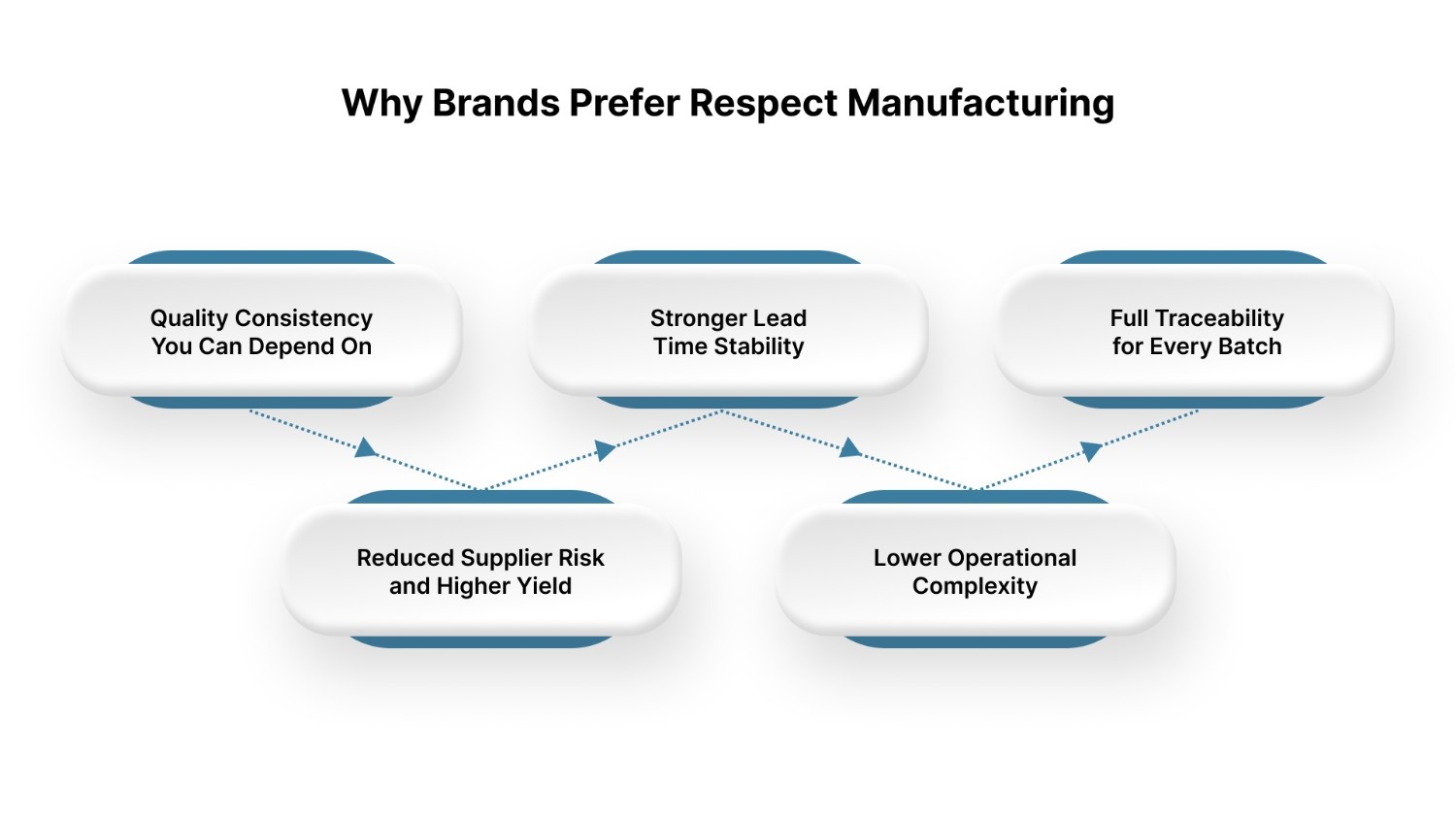
Quality Consistency You Can Depend On: Rigorous AQL checks on all incoming materials, controlled batching, and complete stability programs help prevent potency drift, contamination risks, and batch failures.
Reduced Supplier Risk and Higher Yield: Verified sourcing, identity testing, and component control reduce variability and protect yield improvement across every production run.
Stronger Lead Time Stability: Integrated scheduling aligns formulation, blending, production, stability testing, and packaging under one timeline, supporting reliable throughput and on-time shipments.
Lower Operational Complexity: With formulation, sourcing, production, and packaging handled in one CGMP facility, you avoid the delays and miscommunication common in multi-vendor setups.
Full Traceability for Every Batch: Centralized batch records and documentation provide clear visibility into each material, test result, and production step are critical for audits and long-term compliance.
By choosing a partner that internalizes quality, scheduling, and compliance responsibilities, your brand can scale with confidence. Connect with Respect Manufacturing today to support every step, from developing your formula to applying the final label, is managed with precision and complete traceability.
Conclusion
Launching your own supplement means making informed decisions from the start, from market research and formulation to sourcing, CGMP manufacturing, packaging, and release. When these steps are aligned, you gain predictable lead times, stable CPU, and consistent output as you scale.
A turnkey partner like Respect Manufacturing strengthens this path by integrating formulation, production, packaging, and testing within one compliant system, helping brands bring high-performing supplements to market with confidence.
Optimize Your Supplement Production Now. Contact us to discuss your next supplement batch.
FAQs
1. What do I need before manufacturing my supplement?
A defined target customer, clear product concept, regulatory plan, and realistic MOQ expectations.
2. Do supplements need FDA approval?
No. The FDA regulates manufacturing and labeling through CGMP, but does not pre-approve supplements.
3. How do I decide between private label and custom formulation?
Choose private label for speed and cost efficiency; choose custom formulation for a unique, defensible product.
4. What factors influence Cost Per Unit (CPU)?
Ingredient quality, packaging formats, MOQs, testing requirements, and operational efficiency.
5. What should I look for in a manufacturing partner?
Check CGMP compliance, testing capability, material control systems, production capacity, and turnkey support.