Launching a nootropic product sounds simple until you face the operational pressure behind it: ingredient verification, supplier dependability, documented testing, and retailer requirements that leave no room for unclear processes.
That pressure is real. McKinsey’s latest wellness report shows that clinical effectiveness is now one of the top decision drivers for consumers, which means brands can’t rely on generic formulas or vague claims anymore.
For procurement and operations teams, this shifts the priority from “launch fast” to “launch with control.” You need supply-chain clarity, label accuracy, audit-friendly documentation, and a partner who can support stable lead times and lower supplier risk.
This guide will help you evaluate private-label nootropics through an operational lens: how formulas differ, what to check in a manufacturer’s processes, which compliance risks to flag early, and how to avoid delays or rework during scale-up.
Key Takeaways:
Private-label speed: 4–8 week development cycles help reduce R&D load and shorten time-to-shelf compared with 12–24+ weeks for custom formulations.
Demand shift: McKinsey reports clinical effectiveness is now a top consumer decision driver, increasing pressure for documented, evidence-based formulas.
Operational clarity: Formats, COAs, stability data, and retailer compliance directly influence lead-time reliability, scrap rate, and rework risk.
Risk control: Most launch delays stem from preventable issues, missing COAs, weak stability data, or labeling errors, all of which impact batch release and OTIF performance.
Partner capability: Respect Manufacturing provides an FDA-registered, CGMP-aligned facility with automated stainless steel lines and AQL testing, supporting stable, low-variance production.
What Are Private Label Nootropics?
Private-label nootropics are finished supplement formulas produced by a third-party manufacturer and sold under your brand. The product itself is pre-formulated (or only lightly adjusted), while you control branding, pack format, and go-to-market. This route trades customisation time for speed, lower upfront capital, and predictable production workflows
Below are the practical distinctions and the operational impacts you must quantify before choosing a private-label path.
Private label (definition): Off-the-shelf or lightly tuned formulas a manufacturer produces for multiple brands; you brand and sell the finished SKU. Operational impact: faster pilot runs and shorter time-to-shelf compared with custom development.
White label (difference): A subtype of private label that’s usually fully standardized and sold to many brands with minimal change; lowest complexity, lowest differentiation. The operational impact is minimal setup time, but a higher risk of competing on identical SKUs.
Custom formulation (contrast): Bespoke blends developed to your brief and typically owned by you. Operational impact: longer development cycles, higher MOQ/tooling exposure, but stronger IP control and tighter yield/scrap management.
Common formats: Nootropics commonly come as capsules, powders, gummies, and RTD (ready-to-drink) shots. Each format affects line changeover time, tooling needs, and stability/testing requirements. Plan SKUs around throughput and packaging lead times.
Why growth brands pick private label: It reduces CAPEX, shortens launch cycles, and lets teams test SKUs with lower supplier onboarding overhead. It is useful for proving product-market fit before committing to custom formulation.
Key operational tradeoffs to measure: Map private-label choice to KPIs; expected changeover time, initial scrap rate on first runs, forecast flexibility (ability to absorb demand variance), and impact on warehouse turnover and reorder cadence. (Quantify these before signing MOUs.)
With the core definitions clear, the next step is understanding what’s driving demand across the nootropics category.
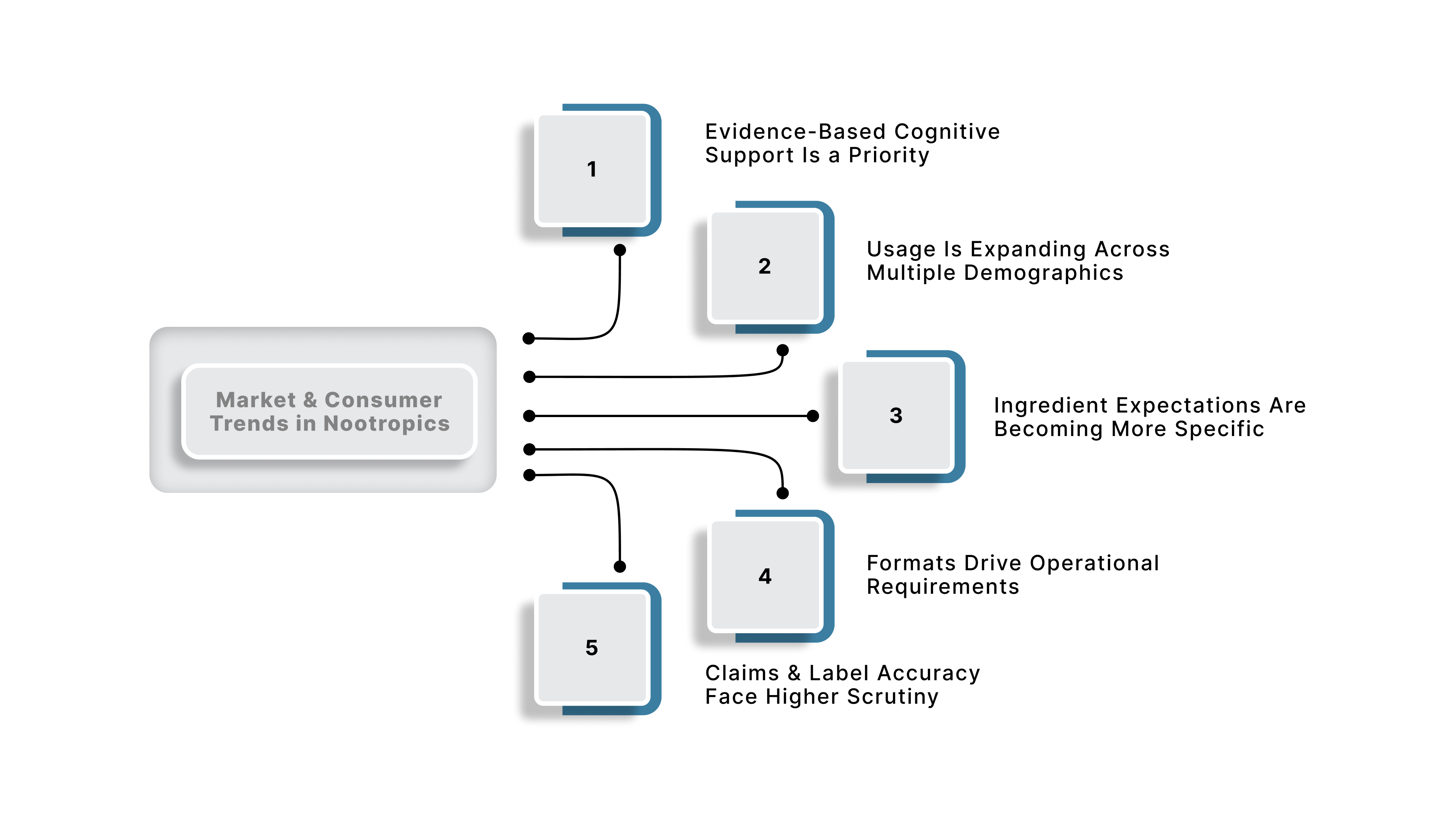
Market & Consumer Trends in Nootropics
Nootropics are now evaluated on formulation clarity and ingredient transparency. Retailers expect documented evidence for cognitive-support claims, and they’re asking manufacturers for cleaner spec sheets and consistent batch data.
This affects routine supplier decisions, from confirming COAs to choosing formats that reduce changeover time. For operations teams, these trends influence lead-time reliability, rework risk, and the ease with which a product can move through compliance checks before launch.
Here are the trends influencing demand and what each one means for your manufacturing, compliance, and operational KPIs.
1. Evidence-Based Cognitive Support Is a Priority
Buyers increasingly look for ingredients with published research or clinical references, not generic blends.
KPI Impact: Requires tighter spec sheets and QC documentation, reducing customer complaints and rework tied to inconsistent batches.
2. Usage Is Expanding Across Multiple Demographics
Students take nootropics for focus, professionals for sustained attention, and older adults for memory support.
KPI Impact: Forecasting must account for multi-channel demand patterns, improving inventory turnover, and reducing holding costs.
3. Ingredient Expectations Are Becoming More Specific
Nootropics are shifting toward identifiable, functional components: mushroom extracts, adaptogens, choline sources, rather than vague “energy blends.”
KPI Impact: Increases dependency on verified ingredient suppliers and COAs, helping reduce batch variability and supplier-risk exposure.
4. Formats Drive Operational Requirements
Capsules offer predictable runs; gummies require different cook processes; powders introduce dust-control and blending consistency considerations; RTDs add stability and packaging constraints.
KPI Impact: Impacts equipment uptime, changeover frequency, and throughput; directly influencing lead-time reliability.
5. Claims and Label Accuracy Face Higher Scrutiny
Regulators and retailers are taking firmer positions on brain-health claims, demanding that wording align with substantiated evidence.
KPI Impact: Reduces the risk of relabeling runs, compliance delays, or shipment holds due to incorrect or overstated claims.
If you’re evaluating partners who can meet these documentation and process requirements, Respect Manufacturing offers CGMP-aligned production, AQL testing, and turnkey support that can fit into this operational model.
These trends also influence a key decision point: when to use a private-label formula and when to invest in a custom build.
Private Label vs Custom Formulations
Choosing the wrong route delays launch and raises costs. McKinsey found that about 92% of B2B procurement leaders plan to increase private-label purchases, boosting private-label volume by roughly 21% over the next 1–3 years.
Align your development model to timing, CAPEX, and QC capacity. Use the table below to pick the path that protects shelf access and operational stability.
Factor | Private Label | Custom Formulation (OEM/CMO) |
|---|---|---|
Development Time | 4-8 weeks (ready-formulas) | 12-24 weeks (6-12 months for some complex builds) |
Upfront Cost / R&D | Lower initial investment; minimal R&D required | Higher upfront cost due to formulation development, testing |
Lead-Time Stability | More predictable; the manufacturer has an existing process | More variability, formulation tweaking, and pilot batches impact timelines |
Supplier Dependency | The formula is usually shared; switching manufacturers is harder | Brand owns the formula; switching manufacturers is easier, but the initial change management is higher |
Differentiation | Moderate — pre-formulated, may limit uniqueness | High — proprietary formula supports unique brand positioning |
QC Complexity & Risk | Lower — formulas already validated by the manufacturer | Higher — additional QA, stability testing, formulation risk |
Cost per Unit | Generally, lower initial unit costs during early production runs | Higher unit costs initially, but can improve with scale and an exclusive formula |
Best Use Case | Quick launch, limited budget, testing new channels | Established brand, niche positioning, long-term planning |
From here, success depends on choosing a manufacturer that can execute your plan reliably and scale with your requirements.
Choosing the Right Manufacturing Partner
Many brands underestimate how much manufacturing misalignment adds to operational risk: inconsistent QC, undocumented materials, and multiple vendors can delay launches and raise cost per unit.
Respect Manufacturing mitigates these issues by offering a state-of-the-art, FDA-registered facility, stainless steel automated lines, full turnkey capability, and rigorous AQL testing on raw materials and finished goods.
Here are key operational criteria where Respect Manufacturing adds measurable value:
Facility standards: “FDA-registered, stainless-steel automated production lines” ensure repeatable throughput and fewer production disruptions
One-stop turnkey workflow: From R&D and formulation to primary and secondary packaging; reduces coordination overhead and multi-vendor risk.
Rigorous testing infrastructure: Inbound AQL for ingredients + outbound testing + detailed stability programs ensure lower defect rates and faster approvals.
Packaging & supply-chain scale: Offers formats like stickpacks, sachets, bottles, jars, tubes, sample packaging, and refills; supports SKU expansion without moving lines.
Traceability & transparency: Documentation and process controls (CGMP-aligned) support audit readiness and reduce time spent on supplier oversight.
With production capabilities defined, you can move into the practical steps required to take a nootropic product to market reliably.
Go-to-Market Planning & Launch Strategy
A clear go-to-market plan helps reduce rework, prevent shipment holds, and stabilize production schedules. Here is a simple sequence to organize your launch and reduce operational risk.
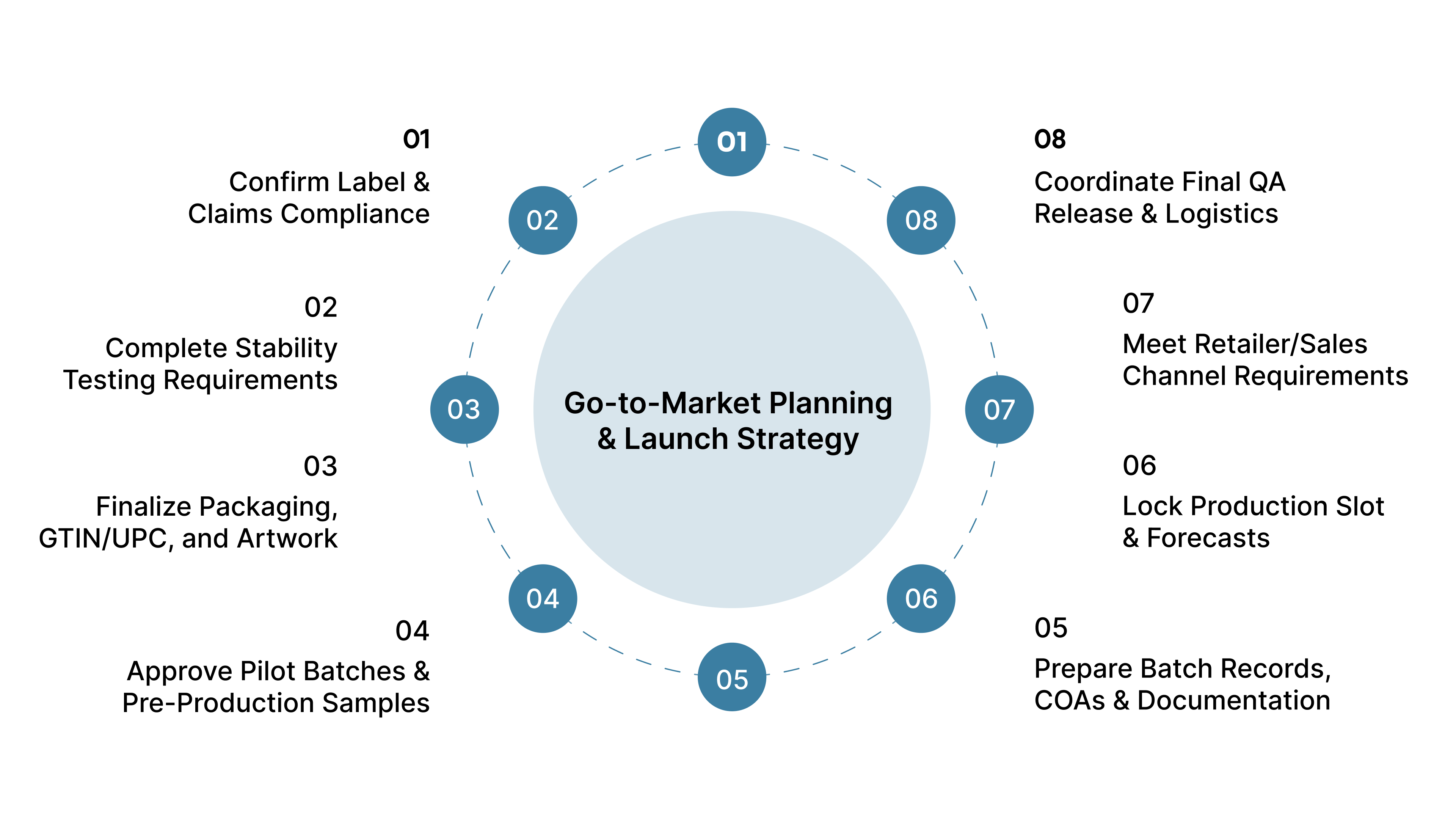
Step 1: Confirm Label & Claims Compliance
Meet FDA cosmetic or DSHEA supplement requirements. Ensure ingredient lists, claims, and mandatory statements are correct before printing.
Step 2: Complete Stability Testing Requirements
Use long-term and accelerated stability data to support shelf-life, packaging choice, and retailer approvals.
Step 3: Finalize Packaging, GTIN/UPC, and Artwork
Assign GS1 GTINs, validate barcodes, and complete artwork approval before production scheduling.
Step 4: Approve Pilot Batches & Pre-Production Samples
Run engineering or pilot batches to confirm blend performance, fill accuracy, and packaging compatibility.
Step 5: Prepare Batch Records, COAs & Documentation
Ensure all records, COAs, and traceability documents can be delivered to buyers or auditors on request.
Step 6: Lock Production Slot & Forecasts
Align MOQs, lead times, and supply forecasts to reduce changeovers and avoid capacity conflicts.
Step 7: Meet Retailer/Sales Channel Requirements
Confirm channel-specific rules (OTIF, SQEP, Amazon cGMP documentation, etc.) before shipping.
Step 8: Coordinate Final QA Release & Logistics
Release finished goods with complete QC data, and schedule shipments aligned with launch windows.
Suggested Read: What's a Batch Code: Meaning, Uses & Why It Matters
With the core steps defined, it’s important to understand the operational pitfalls that can disrupt your launch.
Operational Challenges & Pitfalls to Avoid
Most production delays come from preventable operational errors: missing COAs, incorrect labels, unstable formulations, or unverified packaging. These issues slow batch release, interrupt schedules, and trigger retailer rejections.
To maintain stable lead times and reduce rework, brands need clarity on where operations typically break down. The table below highlights the core risks and how to control them.
Challenge | Why It Matters (KPI Impact) | How to Avoid / Workaround |
|---|---|---|
Microbial contamination | Increases rework, delays batch release, raises recall risk. | Require inbound AQL testing, clear microbial specs, and release-on-COA rules. |
Weak stability data | Leads to relabeling, launch delays, and retailer rejection. | Set long-term + accelerated stability requirements in the contract; approve only post-stability checkpoints. |
Raw-material variability / missing COAs | Causes inconsistent potency and higher scrap. | Use approved supplier lists, mandatory COAs for every lot, and periodic third-party testing. |
Label or claims non-compliance | Creates relabel runs, shipment holds, and legal exposure. | Lock claim language early; require regulatory sign-off and compliant artwork before printing. |
Packaging or barcode errors | Triggers retail rejections and OTIF penalties. | Pre-verify GTIN/UPC, run barcode quality checks, and approve print proofs before production. |
MOQ and forecasting mismatch | Leads to stockouts, excess inventory, and unstable lead times. | Use tiered MOQs, rolling forecasts, and documented lead-time commitments. |
Uncontrolled change orders | Causes batch inconsistency and delays. | Enforce written change-control steps and pre-production sample approval. |
Slow documentation or limited audit access | Slows root-cause analysis and compliance processes. | Set SLAs for COAs/batch records and include annual + for-cause audit rights. |
Retail compliance failures | Causes fines and lost shelf space. | Align product specs, packaging, and delivery windows with each retailer’s onboarding rules. |
Also Read: Top 10 Cosmetic Contract Manufacturers in the USA 2025
Conclusion
The final decision in any nootropic launch isn’t about formulas or formats, it’s about how much operational risk you’re willing to carry. The most reliable teams are the ones that keep three things non-negotiable: documented processes, stable lead times, and full traceability across every batch.
If those three fall into place, everything else becomes easier: retailer onboarding, scale-up, and multi-SKU expansion.
This is where a manufacturing partner’s actual infrastructure matters. Respect Manufacturing operates an FDA-registered, CGMP-aligned facility with automated stainless steel lines and full AQL testing. Their turnkey workflow covers formulation, packaging, and final delivery within one accountable system.
Connect with Respect Manufacturing to assess operational fit and ensure the production workflow supports your scale and compliance goals.
FAQs
1. What is the main advantage of choosing private-label nootropics?
You can launch faster because the formulas are already developed and validated, which reduces R&D time and lowers upfront cost.
2. Do I still need stability testing for private-label products?
Yes. Even pre-formulated products require stability data to support shelf life, packaging decisions, and retailer onboarding.
3. What should I verify before selecting a private-label manufacturer?
Check their facility standards, documentation process, COAs, packaging capability, and ability to meet your lead-time and QC requirements.
4. Can I customize a private-label nootropic formula?
Manufacturers often allow light modifications, but major changes usually require moving to a custom formulation workflow.
5. When does private label stop being the right choice?
When you need stronger differentiation, control over IP, or better long-term cost efficiency through formulation ownership.