Building a supplement or personal wellness brand is exciting, but it becomes increasingly complex as demand grows and production risks scale with you. Many founders and operations teams feel this pressure as they work to protect lead times, control supplier variability, and maintain consistent product quality.
The global dietary supplements market projected grow at a CAGR of 8.73% from 2024 to 2032, according to Fortune Business Insights. It is natural to look toward NSF certified supplement manufacturers for added credibility, yet certification alone does not simplify production or remove operational strain.
When stability and clear accountability matter most, a turnkey current good manufacturing practices (CGMP) partner offers a more dependable path. This article outlines why the turnkey model supports scaling brands better and where NSF certified supplement manufacturers may fall short in throughput and accountability.
Key Takeaways
NSF certification verifies product purity and label accuracy, but it does not streamline multi-vendor operations.
Turnkey CGMP partners centralize formulation, sourcing, manufacturing, testing, and logistics under one accountable system.
Unified workflows reduce Downtime Reduction, Supplier Risk, Scrap Rate, and operational bottlenecks.
Turnkey partners offer stronger Lead Time Stability and faster time-to-market for scaling brands.
For high-growth companies, a turnkey CGMP model often delivers greater long-term value than NSF certified supplement manufacturers.
Before comparing NSF certified supplement manufacturers with turnkey CGMP partners, it helps to understand what NSF certification actually represents and how it fits into the broader manufacturing landscape.
What Is NSF Certification?
NSF certification is a third-party audit program that verifies whether a supplement manufacturer meets defined standards for product purity, label accuracy, and Good Manufacturing Practices. It is most commonly recognized for reducing risks related to ingredient contamination and adulteration.
What NSF Certification Covers
Validates consistent production and quality practices
Confirms finished products match label claims
Screens for contaminants such as heavy metals, microbes, and banned substances
Reviews documentation and sampling procedures for accuracy
What NSF Certification Does Not Cover
Does not integrate R&D, sourcing, packaging, or logistics
Does not guarantee line efficiency or throughput performance
Does not ensure supplier control or component dimensional accuracy
Does not manage multi-vendor coordination
NSF certification is a useful quality marker, especially for consumer trust and certain retail channels. However, for brands scaling from $2 million to $100 million, it does not address the operational pressures that affect Scrap Rate, equipment uptime, or supplier risk. That requires a fully integrated CGMP system.
Understanding the scope and limits of NSF certification makes it easier to compare it with the turnkey CGMP model, which focuses on unifying the entire supply chain under one accountable partner.
Understanding the Difference Between NSF Audit and Turnkey System
Many teams assume that NSF certification automatically indicates a more advanced operational environment. In reality, NSF certification is a targeted audit of product integrity and facility compliance. A turnkey CGMP partner delivers a full operational system that manages upstream and downstream activities, not just the final manufacturing step.
NSF Audit vs Turnkey System
Feature | NSF Certified Supplement Manufacturers | Turnkey CGMP Partner (e.g., Respect Manufacturing) |
Primary Focus | Product purity and label claim verification | End-to-end supply chain integration and consistency |
Accountability | Fragmented across multiple vendors | Single-source accountability across R&D, sourcing, and production |
Operational Impact | Reduces product-level risks only | Reduces Downtime Reduction, Scrap Rate, and lead time volatility |
Key Advantage | Recognizable third-party verification | Faster scheduling, unified quality, and controlled throughput |
Cost Driver | Certification fees and repeated product testing | Reduced Cost Per Unit and Economies of scale through integrated processes |
This distinction is important for Operations and Procurement teams evaluating long-term scalability, not just certification badges.
NSF certification strengthens product purity verification and label-claim confidence. For scaling brands, however, the operational risks that affect throughput and cost, such as material qualification, AQL checks, equipment readiness, changeover time, and scheduling control, are governed by the manufacturer's CGMP execution and integrated processes.
These operational controls, not certification alone, determine batch consistency, lead time stability, and long-term scalability.
Also Read: FDA Cosmetic Labeling Requirements Guide
Once the structural differences become clear, the next question is how these models behave in real operations. The first and most costly friction point appears when multiple vendors need to be coordinated.
The Operational Cost of Fragmentation: Where NSF Falls Short
Many procurement and operations leaders manage 10 to 20 SKUs across several formats. When choosing an NSF certified supplement manufacturer for the filling stage only, they still face fragmented ownership across the rest of the supply chain.
The Fragmented Workflow Challenge
If you choose an NSF-certified filler, you still need to manage:
R&D and formulation with a separate specialist
Packaging sourcing across multiple vendors
Logistics between component suppliers and the filling facility
Shipping finished goods to a warehouse or 3PL
This creates recurring accountability gaps. A dimensional mismatch in a cap that jams the filling line becomes a costly standstill. The filler blames the packaging vendor. The vendor blames the sourcing agent. Your operations team absorbs the downtime.
The Turnkey Advantage: Unified Liability
Turnkey CGMP partners eliminate these gaps by centralizing responsibility.
R&D is developed for your automated lines, reducing compatibility risks.
Component sourcing and AQL inspections are integrated, preventing packaging-driven stoppages.
One contract and one schedule remove multi-vendor friction and improve lead time stability.
Turnkey CGMP partners also support multiple dosage formats, such as capsules, tablets, powders, and liquids, which is essential for brands planning SKU expansion.
Note: Respect Manufacturing applies rigorous Acceptance Quality Limit (AQL) inspection at the component level to catch faults before they hit the line. This is a core step in reducing operational interruptions.
Also Read: How To Meet FDA MoCRA Requirements For Mandatory Cosmetic And Facility Registration In 2026
Operational gaps are only one part of the picture. The bigger risk comes from how quality is executed on the factory floor, not how it is certified on paper.
Why CGMP Execution Matters More Than the NSF Seal
NSF certification confirms that a facility meets defined quality and purity standards, but it does not govern how efficiently or consistently your product runs on the line. CGMP execution defines the daily discipline that dictates quality, throughput, and risk.
The Foundation: FDA CGMP Requirements
cGMP standards include:
Complete Batch Record traceability for every ingredient and component
Personnel training and qualification
Controlled facility design, cleaning, and calibration
Documented In-Process Checks
CGMP compliance is mandatory. What distinguishes partners is how well they operationalize it.
The Turnkey Enhancement: Integrated R&D and Production
Turnkey CGMP partners, like Respect Manufacturing, strengthen cGMP execution through:
Integrated Stability Testing that reflects real packaging interactions
Facility-wide material control to reduce Supplier Risk
Precise calibration and consistent filling to protect the Cost Per Unit
Continuous In-Process Checks that prevent downstream failures
Want your root causes of operational loss to be addressed? What's better than a turnkey CGMP partner? Connect with Respect Manufacturing and put an end to your problems.
Even with strong quality systems, your long-term growth depends on whether your manufacturer can scale with you. This is where the difference between NSF-certified facilities and turnkey CGMP operations becomes even more pronounced.
The Scalability Trap: Flexibility vs High-Volume Throughput
Scaling brands need partners that can support low minimum order quantities (MOQs) for new innovations while simultaneously managing high throughput for best sellers. NSF certification does not guarantee this operational versatility.
Where NSF Facilities May Struggle
Higher overhead from certification requirements may limit format flexibility.
Facilities may specialize heavily in NSF-oriented runs, reducing adaptability.
Small pilot batches may be deprioritized due to volume demands.
Turnkey Flexibility and Throughput Benefits
Turnkey CGMP partners provide both adaptability and scale due to integrated scheduling, modular production systems, and packaging versatility.
Operational Factor | Turnkey CGMP Benefit | Impact on Scaling Brand |
Changeover Time | Streamlined, validated procedures | Faster SKU launches, higher Equipment Uptime |
Packaging Diversity | Support for bottles, jars, tubes, stickpacks, etc. | Eliminates the need for multiple vendors |
Supplier Risk | Single vendor qualification | Lower administrative load and fewer delays |
Note: Turnkey CGMP partners build predictable, repeatable systems that support both pilot runs and high-volume scale.
Also Read: Guidelines for FDA Cosmetics Compliance
When scaling pressures rise, brands need more than compliance. They need a predictable system that speeds launches, protects the budget, and reduces operational workload. This is where the turnkey model shifts from an efficiency benefit to a strategic advantage.
The Strategic Value of a Turnkey Partnership
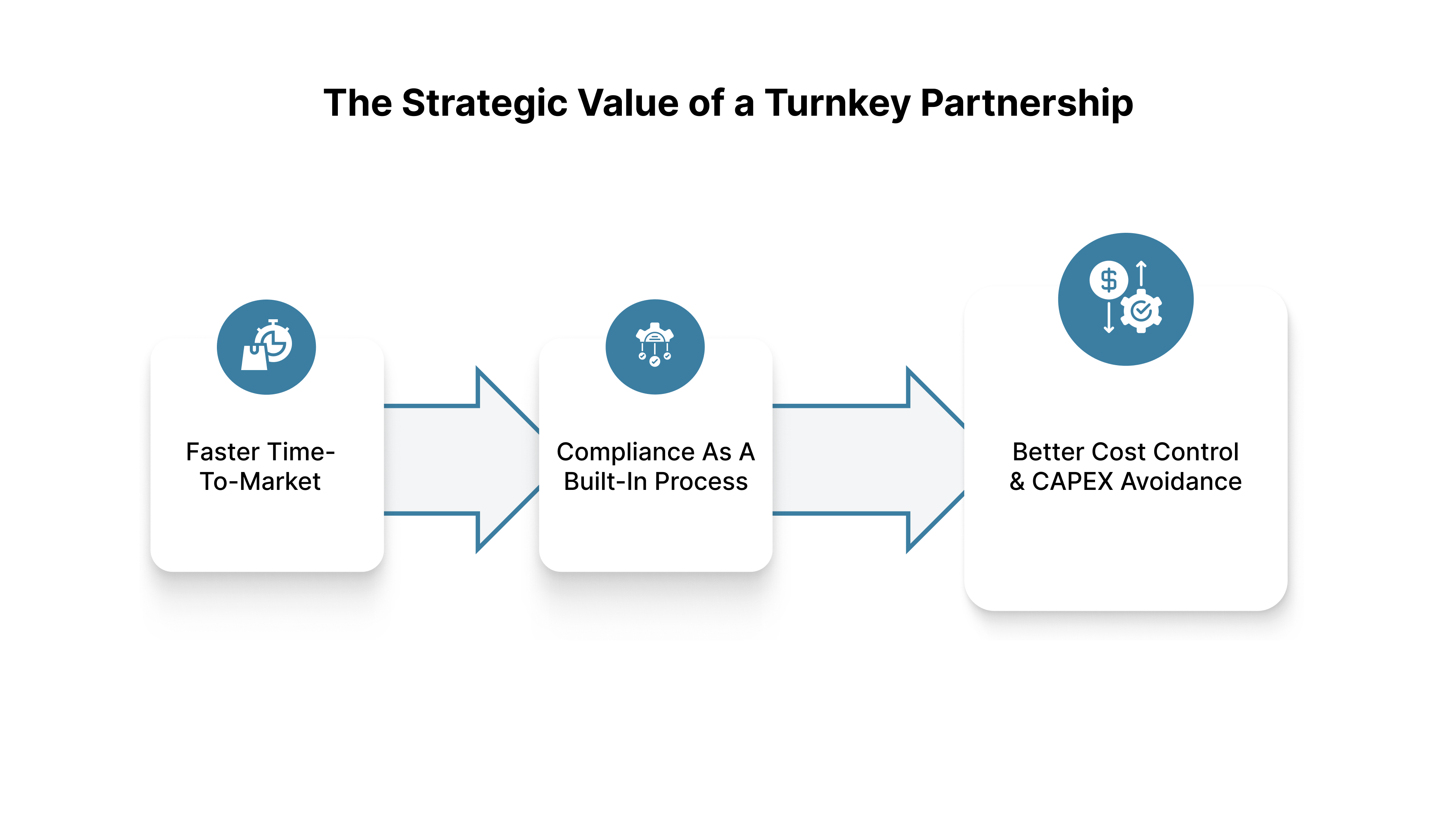
Turnkey manufacturing is not only an operational upgrade but also a strategic resource for executives responsible for margin, throughput, and compliance.
1. Faster Time-to-Market
Internal scheduling replaces cross-vendor coordination, eliminating delays between R&D, packaging, filling, and testing.
2. Compliance as a Built-in Process
Turnkey QA teams verify every step, not just the final product.
Continuous In-Process Checks
Batch Record oversight
Unified Lot and Expiry coding
This simplifies audits and reduces legal exposure.
3. Better Cost Control and CAPEX Avoidance
Turnkey CGMP partners run high-efficiency automated lines, which:
Reduce Scrap Rate
Improve Throughput
Minimize product giveaways.
Lower Cost Per Unit
Brands avoid investing capital in their own filling, packaging, or stability testing infrastructure.
With these operational gaps in mind, it becomes clearer how a turnkey CGMP system supports what NSF certification alone cannot. This is where Respect Manufacturing adds meaningful value for scaling brands.
How Respect Manufacturing Adds Value for Scaling Wellness Brands
Respect Manufacturing is structured to eliminate the accountability gaps that occur when R&D, sourcing, filling, testing, and packaging are split across multiple vendors. By integrating these functions under one CGMP-compliant system, brands gain predictable throughput and a single point of operational control.
Key Advantages for Operations and Procurement Teams
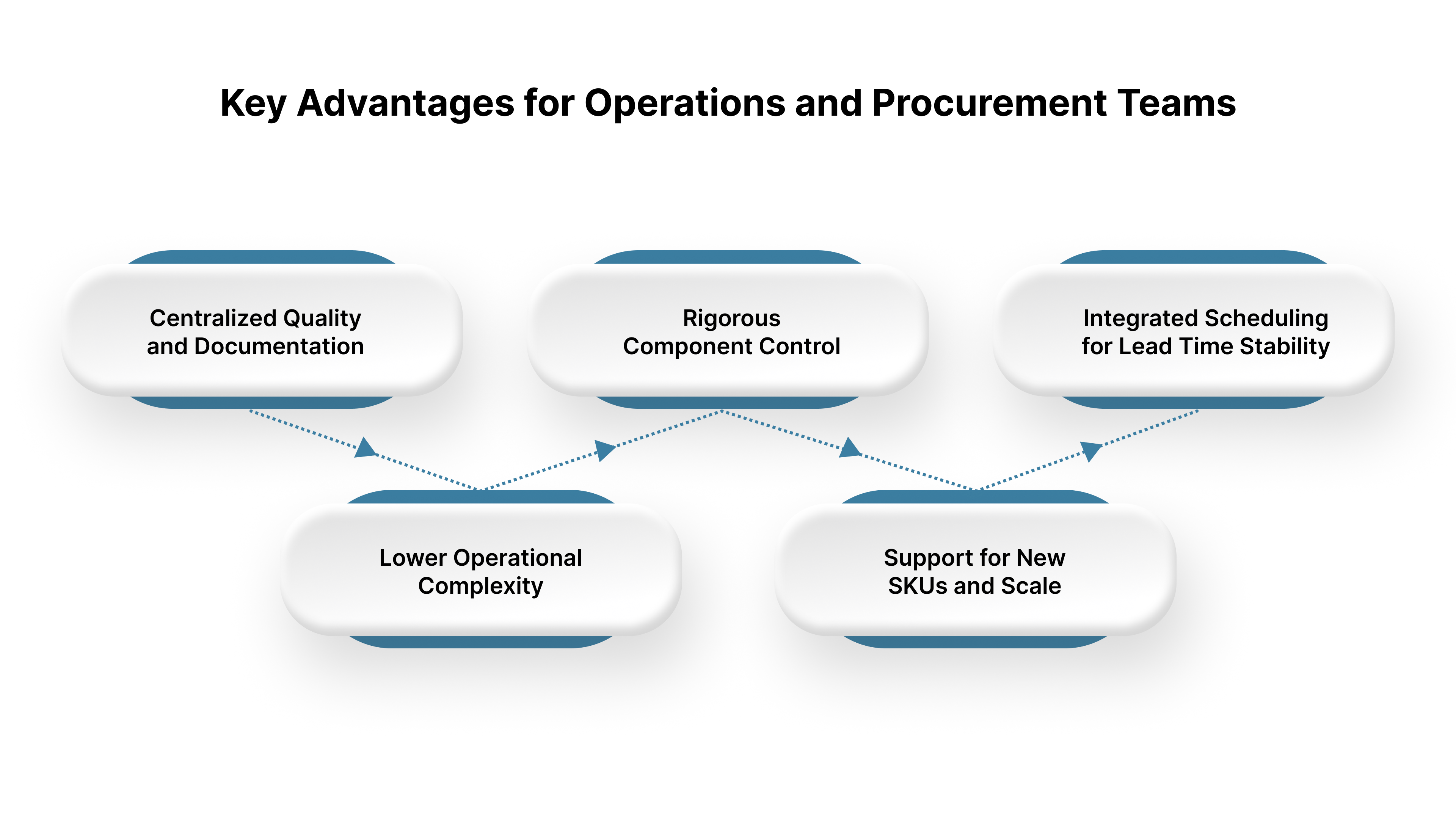
Centralized Quality and Documentation: Unified Batch Records, IQC results, and in-process checks reduce compliance risk and simplify audits.
Rigorous Component Control: Every bottle, cap, liner, and label undergoes dimensional and functional checks to prevent line stoppages and protect equipment uptime.
Integrated Scheduling for Lead Time Stability: Formulation, material qualification, production, and packaging follow one schedule, reducing delays and unplanned bottlenecks.
Lower Operational Complexity: A single partner manages formulation, sourcing, manufacturing, packaging, and logistics, reducing administrative load and multi-vendor risk.
Support for New SKUs and Scale: Automated lines and flexible packaging formats allow fast-moving brands to scale or diversify without switching vendors.
This integrated model helps fast-growth brands maintain consistency, reduce CPU volatility, and scale without the fragmentation that often slows mid-market companies.
Also Read: How to Build Your Own Brand Products: A 7-Step Guide to Turn Ideas into Market-Ready Products.
Conclusion
The choice between NSF certified supplement manufacturers and a turnkey CGMP partner depends on your primary operational need. If your focus is on third-party verification for specific product categories, NSF certification can support that requirement.
However, NSF does not address the daily operational pressures that scaling brands face, such as supplier variability, component failures, handoff delays, or unstable lead times. Turnkey CGMP partners provide centralized accountability, lower supplier risk, fewer handoff delays, stronger lead time stability, and consistent throughput.
Respect Manufacturing is built on FDA-mandated cGMP standards and integrates formulation, stability testing, material control, manufacturing, packaging, and logistics into one effortless system. This eliminates coordination gaps and protects your operational performance as you grow.
Ready to reduce complexity and scale with confidence? Work with a single turnkey CGMP partner that manages formulation, sourcing, production, testing, and logistics under one accountable system. Connect with Respect Manufacturing today to stabilize your lead times, protect product quality, and accelerate throughput.
FAQs
1. Does NSF certification guarantee smoother operations for scaling brands?
No. NSF focuses on product purity and label-claim accuracy. It does not address Supplier Risk, AQL inspection, line compatibility, or lead-time stability, which are the core operational priorities for scaling companies.
2. What operational advantage does a turnkey CGMP partner offer over NSF certified supplement manufacturers?
A turnkey partner centralizes formulation, sourcing, QA, filling, packaging, and logistics. This removes handoff delays, reduces downtime reduction, and improves throughput.
3. How does a turnkey model impact Cost Per Unit (CPU)?
By managing sourcing, AQL, equipment calibration, and automated runs under one schedule, a turnkey partner reduces Scrap Rate and changeover losses. This stabilizes the CPU as volume grows.
4. Is NSF certification required for all supplement brands?
No. It is optional unless targeting specific retail programs or athletics certifications. Most D2C brands in the $2 Million to $100 Million range prioritize CGMP execution, not NSF audits.
5. When should a brand switch from multiple vendors to a turnkey manufacturer?
When lead times become unpredictable, component failures increase scrap, or your CPU rises due to fragmented workflows. A turnkey partner resolves these issues by owning the whole process.