Interactive packaging is reshaping how consumers experience products. It turns packaging from something you simply open into something you engage with.
Scan it. Tap it. Twist it. Explore it.
For beauty, wellness, and CPG brands, this shift matters. Retail shelves are crowded. Online listings blur together. Consumers expect more than a static label and a barcode. They want information, storytelling, and moments that feel personalized.
Interactive packaging delivers exactly that by bridging the physical and digital experience. It educates, entertains, and strengthens brand connection in a way traditional packaging cannot.
In this article, we explore what interactive packaging is, why it works, the formats that drive engagement, and how brands can implement it effectively.
Key Takeaways:
Interactive packaging transforms products into digital or functional experiences that boost education, transparency, and engagement.
QR, NFC, AR, peel-and-reveal layers, and functional mechanisms are the most effective formats for beauty, wellness, and supplements.
Real value comes from ingredient details, authenticity checks, refill prompts, tutorials, and immersive storytelling.
Key failures include poor scannability, gimmicks with no purpose, missing compliance, and no plan to maintain digital content.
Best results come from simple interactions, reliable testing, strong usability, and packaging that works across devices and production lines.
Respect Manufacturing helps brands execute interactive packaging that is compliant, scalable, and production-ready.
What Is Interactive Packaging?
Interactive packaging refers to any packaging that allows the consumer to engage with it in a meaningful, action-driven way. Instead of only displaying information, interactive packaging invites users to scan, tap, reveal, or activate elements that extend the product experience.
Static packaging stops at visuals and text. Interactive packaging adds a digital or functional layer that responds to the user. This can include QR codes, NFC tags, AR experiences, peel-and-reveal messages, authentication checks, dosage mechanisms, or reusable systems.
In simple terms, static packaging tells. Interactive packaging involves. It connects the physical product to digital content, reinforces brand storytelling, and helps consumers learn, explore, and interact in real time.
Why Interactive Packaging Matters for Modern Brands
Interactive packaging gives brands new ways to engage consumers, communicate value, and stand out in competitive categories.
Builds deeper consumer engagement: Packaging becomes an active touchpoint. A quick scan can open a routine guide, product quiz, or personalized dashboard that keeps users interacting longer.
Enhances education and product understanding: Consumers can access ingredient explanations, usage tutorials, or allergen details instantly through a QR code placed on the label.
Supports transparency and trust: Interactive layers help brands share sourcing information, lab results, sustainability data, or authenticity checks, strengthening credibility.
Improves retention and repeat purchase: Links to refill reminders, subscriptions, loyalty rewards, or reorder pages can be built directly into the packaging experience.
Differentiates in crowded categories: AR try-ons, peel and reveal moments, and interactive storytelling help products stand out both online and on shelves.
Strengthens omnichannel marketing: One QR or NFC tap can guide consumers from retail to D2C, social, or education content, creating a seamless brand journey.
Together, these benefits make interactive packaging a strategic advantage for brands looking to elevate engagement and long-term loyalty.
Types of Interactive Packaging (With Real Examples)
Interactive packaging comes in many forms, from digital layers to physical mechanisms. Here are the formats brands use most to build engagement and add value.
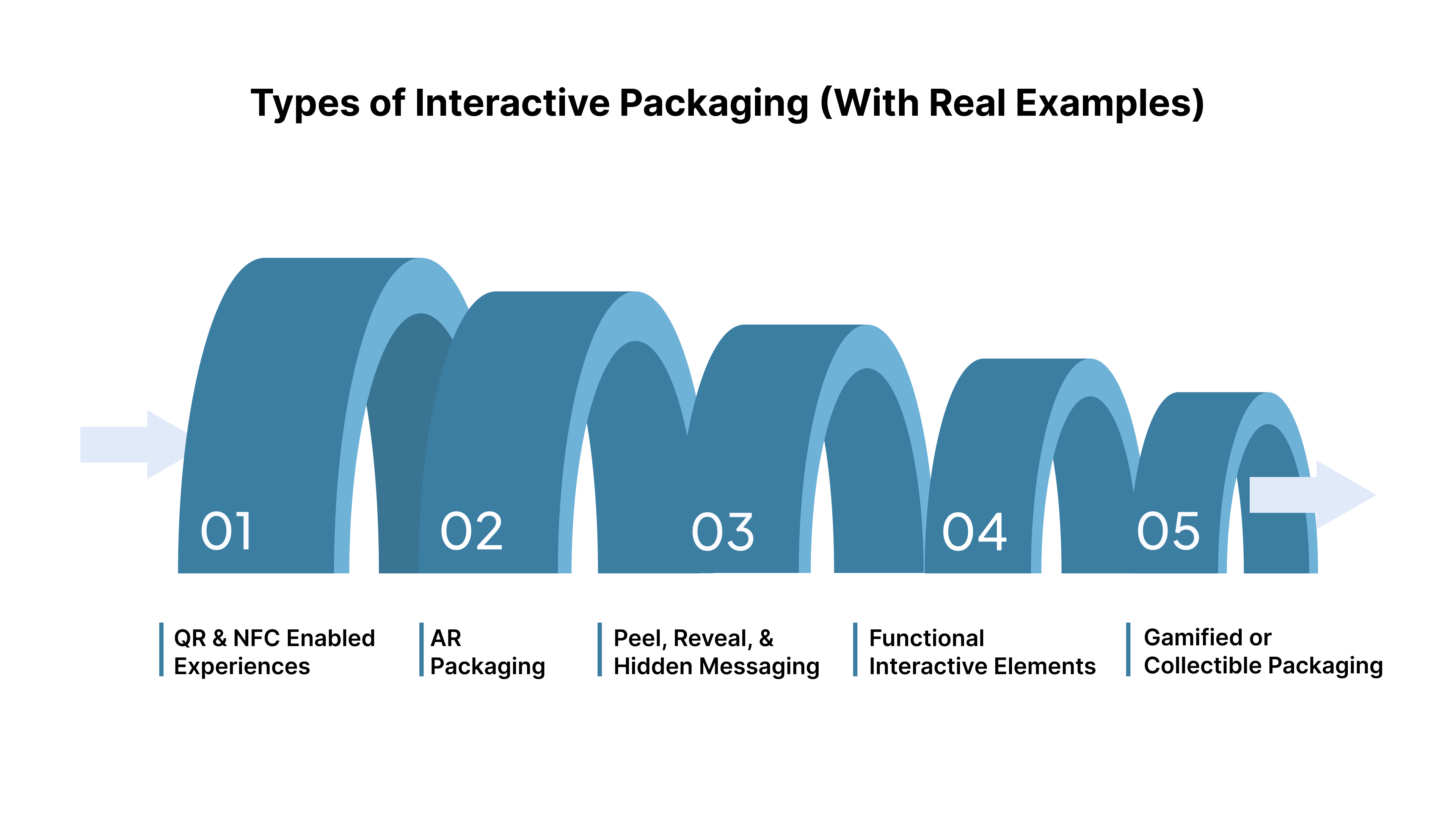
1. QR and NFC-Enabled Experiences
Scannable tech turns packaging into a digital touchpoint. A quick tap or scan unlocks tutorials, ingredient details, authenticity checks, or reordering paths.
How brands use it:
QR codes that unlock tutorials and routine guides
NFC tags for authenticity verification
Scan to subscribe or reorder
Ingredient transparency pages
2. Augmented Reality (AR) Packaging
AR overlays add an immersive layer to packaging. Users can view virtual try-ons, 3D demos, or ingredient stories by scanning the product with their phone.
What this looks like:
Virtual try-ons for makeup or skin tint shades
3D product demonstrations
Ingredient origin journeys or animations
Ritual walkthroughs
3. Peel, Reveal, and Hidden Messaging
Physical reveal moments create surprise and encourage exploration. Hidden codes, messages, or rewards boost engagement during unboxing.
What this looks like:
Peel off tabs with loyalty codes
Hidden messaging that appears when opened
Multi-step opening rituals
Scratch to reveal mini tutorials
4. Functional Interactive Elements
Here, packaging contributes to product performance. Twist to mix activators, refill locks, and dose-controlled pumps improve usability and protect formula integrity.
What this looks like:
Twist to mix packaging for fresh actives
Refill locks for reusable systems
Measured dose pumps or droppers
Flip the indicators that show the remaining product
5. Gamified or Collectible Packaging
Collectible designs, Easter eggs, and scan-to-unlock challenges turn packaging into a playful, shareable experience that strengthens brand loyalty.
What this looks like:
Collectible editions with unique designs
Easter eggs hidden in packaging layers
Challenges unlocked by scanning codes
Seasonal drops and limited artwork
Each of these formats gives brands a practical path to elevate packaging performance while strengthening consumer connection.
Also read: Sustainable Packaging Design Ideas for 2026: A Practical Guide for Scaling Brands
Proven Interactive Packaging Examples from Leading Brands

Consumers now expect packaging to do more than contain a product. They want guidance, transparency, and small moments of delight. These brands show how interactive packaging can deliver all three with simple, well-executed ideas.
1. Clinique Fresh Pressed – Twist-to-Mix Activation System
Clinique uses a press-and-twist mechanism to activate fresh vitamin C at the moment of use, ensuring potency.
Why this works: Functional interactivity protects unstable ingredients and elevates perceived innovation.
2. Fenty Skin – Refillable Packaging With Lock-In Cartridges
Fenty Skin uses durable outer components paired with refill cartridges that lock into place.
Why this works: Reduces waste, supports sustainability messaging, and drives repeat purchases through refills.
3. The Inkey List – Perforated Cartons With Built-In Education
The Inkey List uses folding cartons with a perforated side panel that customers peel open to access extra ingredient education, usage tips, and sustainability details.
Why this works: It delivers extra educational content while keeping the outer packaging clean, simple, and recyclable.
4. McDonald’s Happy Meal – AR Boxes for Interactive Play
McDonald’s uses AR-enabled Happy Meal boxes that kids can scan to unlock mini games and animated characters.
Why this works: Turns simple packaging into a playful experience that boosts engagement and keeps families coming back.
5. Glossier – Collectible Stickers and Limited Packaging Drops
Glossier includes collectible stickers and occasionally releases limited-edition packaging that fans seek out.
Why this works: Creates community-driven engagement and turns packaging into a shareable, collectible moment.
6. Coca-Cola – Detachable Wristband Labels for Festivals
Coca-Cola created bottle labels that peel off and convert into wearable wristbands, some of which unlock access to partnered music festivals.
Why this works: Turns packaging into a functional, collectible item that boosts engagement and drives participation in brand experiences.
7. Nestlé Baby Formula – NFC Tags for Authenticity Verification
Nestlé integrates NFC chips into select formula packaging to help parents verify authenticity and access product information.
Why this works: Protects against counterfeits and provides peace of mind in a highly regulated, trust-sensitive category.
8. Absolut Vodka – Phygital Gifting Bottles With AR Messages
Absolut launched limited phygital bottles featuring unique QR codes that unlock customizable AR messages with voice notes, photos, and text.
Why this works: Blends physical gifting with digital storytelling, creating a memorable, shareable experience that strengthens emotional connection.
9. Lush Cosmetics – Packaging-Free Products With Digital Scans
Lush offers “naked” products where consumers scan in-store displays or use the Lush Labs App to scan products on their phones for ingredient and usage information.
Why this works: Eliminates waste while still providing education through digital interaction.
10. Colgate hum Kids – AR Toothbrush Packaging for Guided Brushing
Colgate’s hum Kids toothbrush includes AR-driven brushing games accessed through the packaging’s onboarding flow, helping children learn proper brushing habits through real-time feedback.
Why this works: Makes oral care fun and educational, turning routine hygiene into a gamified experience that boosts consistency and engagement.
Who Can Utilize Interactive Packaging?
Interactive packaging is no longer limited to big brands with large tech budgets. Any company that wants to improve education, transparency, usability, or consumer engagement can adopt it.
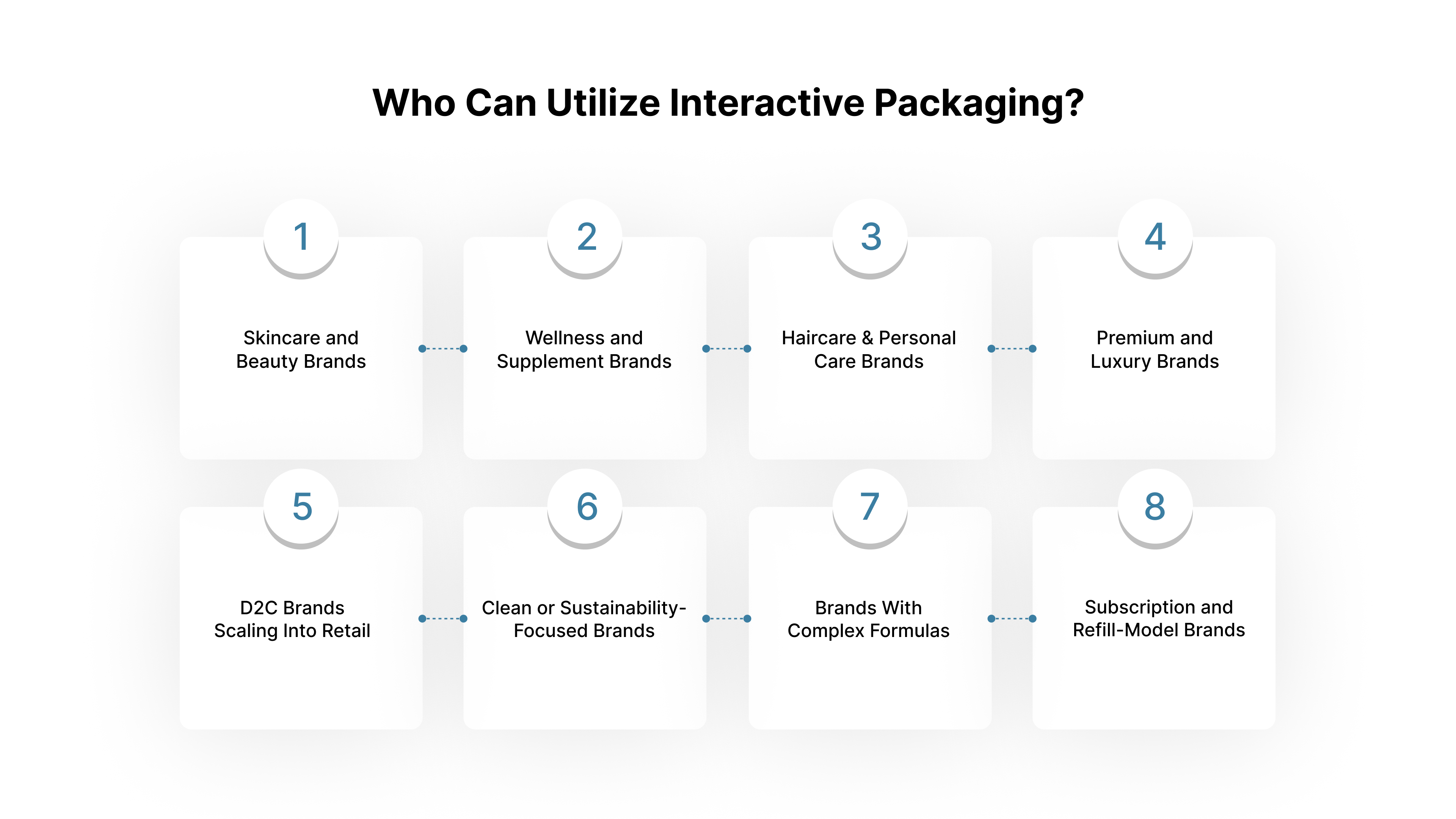
The brands that benefit most include:
Skincare and Beauty Brands: Ideal for ingredient transparency, AR try-ons, refill systems, and routine education.
Wellness and Supplement Brands: Perfect for dosage guidance, quality verification, sourcing transparency, and refill reminders.
Haircare and Personal Care Brands: Useful for tutorial content, scalp or hair diagnostics, and product matching tools.
Premium and Luxury Brands: Enhances storytelling, elevates unboxing, and supports limited-edition or collectible packaging.
D2C Brands Scaling Into Retail: QR codes and NFC tags reduce label clutter while enabling omnichannel onboarding and reducing returns.
Clean or Sustainability-Focused Brands: Interactive layers explain material choices, recycling instructions, and sustainability claims, improving trust.
Brands With Complex Formulas or Regulated Claims: Helps communicate safety, testing data, and usage without overloading the label.
Subscription and Refill-Model Brands: Connects packaging to reorder flows, loyalty programs, or personalized dashboards.
Interactive packaging adds value anywhere consumers need guidance, education, reassurance, or a more immersive brand experience.
Also read: A Practical Guide To Customized Packaging In 2026 For Operations And Procurement
6 Common Mistakes to Avoid With Interactive Packaging
Brands rarely struggle with the technology itself. Most issues come from poor execution or unclear strategy. Avoid these common pitfalls:
Overcomplicating the experience: If consumers need multiple steps, they drop off quickly. Interactions should take under five seconds from scan to value.
Using gimmicks without real value: Consumers expect useful information or functionality. If the interaction doesn’t solve a problem, engagement declines sharply.
Poor QR placement or low scannability: Curved bottles, glossy labels, and small printing reduce scan accuracy. Always test scannability on real production samples.
Not testing across devices or environments: Lighting, shadows, and older phone models impact performance. Ensure your experience works everywhere consumers use the product.
Missing regulatory requirements: Interactive layers cannot replace mandatory printed content. Claims embedded in digital experiences must still follow FDA and FTC rules.
No backend content management plan: QR and AR content requires updates and monitoring. Broken links or outdated pages immediately damage trust and credibility.
These pitfalls slow adoption and frustrate consumers, making interactive packaging feel more like a barrier than a benefit.
Best Practices for Effective Interactive Packaging

Interactive packaging works best when simplicity, usability, and operational efficiency come together. Use these best practices to avoid common pitfalls and create experiences consumers actually use.
Keep the interaction simple and intuitive: Aim for a one-step experience. Consumers should scan, tap, or open the package and immediately get value without navigating multiple screens.
Deliver clear, practical value: Provide something consumers genuinely need, such as routines, usage instructions, ingredient details, authenticity checks, or refill links. Avoid features that feel gimmicky.
Design for high scannability: Place QR codes on flat, matte, and well-lit surfaces. Test on final printed samples to confirm fast scanning across angles and distances.
Test across devices and environments: Check performance on older phones, low bandwidth, fluorescent retail lighting, bright outdoor light, and shadowed bathrooms to ensure a reliable user experience.
Keep printed compliance intact: Ensure all required INCI details, claims, warnings, supplement facts, batch codes, and directions remain on pack. Interactive layers should enhance, not replace, mandatory information.
Plan for ongoing content management: Assign ownership for updating QR content, maintaining AR assets, fixing broken links, and monitoring analytics. Interactive packaging is a system, not a one-time feature.
Ensure operational and technical feasibility: Confirm the packaging structure works on automated lines, supports your formula, and doesn’t interfere with labeling, sealing, or stability.
Following these best practices keeps your interactive packaging useful, reliable, and consumer-friendly while protecting your operational workflow.
Why Brands Choose Respect Manufacturing for Interactive Packaging
Interactive packaging sounds simple on paper, but most brands run into the same operational roadblocks. QR codes that do not scan on curved bottles, labels that cannot fit required claims, components that react with formulas, suppliers who cannot provide documentation, and packaging that slows down automated filling all create friction.
As volumes grow, these issues turn into launch delays, quality risks, and added cost.
Respect Manufacturing helps brands eliminate these problems by uniting formulation, packaging development, testing, and production within a single CGMP-certified system. Instead of coordinating multiple vendors, your team works with one partner that understands how interactive features must align with stability, compliance, and production requirements.
What Respect Manufacturing Delivers
Packaging development through CDW, covering bottles, jars, tubes, stickpacks, sachets, and custom structures
R&D backed compatibility testing to confirm packaging works with active or sensitive formulas
AQL inspections on all packaging components and finished goods to prevent defects in retail channels
Stability, compatibility, and scannability testing under varied lighting, environments, and device types
Automated stainless steel lines that support consistent filling, sealing, labeling, and assembly
Complete documentation, traceability, and quality records for retailer onboarding and regulatory review
Full management of primary and secondary packaging, decorating, printing, and finishing
By aligning interactive design with manufacturing realities, Respect Manufacturing ensures your packaging captures attention as well as performs reliably at scale.
Conclusion
Interactive packaging is becoming a core part of how beauty, wellness, and supplement brands educate consumers, build trust, and differentiate on crowded shelves. When designed well, it transforms packaging from a static container into a dynamic experience that supports transparency, engagement, and repeat purchase.
Respect Manufacturing helps brands bring these ideas to life with packaging that is compatible, compliant, and production-ready. Our integrated formulation, testing, and packaging capabilities ensure every interactive element functions reliably from launch to scale.
Partner with Respect Manufacturing to build interactive packaging that elevates your customer experience and strengthens your brand.
FAQs
1. What is interactive packaging?
Interactive packaging uses QR codes, NFC chips, AR, or functional mechanisms to give consumers added information, digital experiences, or enhanced usability directly through the package.
2. What type of packaging does Gen Z like?
Gen Z gravitates toward bold visuals, sustainable materials, QR or AR experiences, refillable formats, and packaging that feels fun, transparent, and tech-enabled.
3. What is an example of intelligent packaging?
Intelligent packaging includes features like QR-based authenticity checks, sensors that track freshness, or NFC tags that trigger personalized digital content.
What are the 5 P's of packaging?
The 5 P’s are Protection, Preservation, Presentation, Promotion, and Perception — covering safety, shelf life, branding, communication, and how consumers interpret the product.