Testing cosmetics for safety and efficacy is essential to meet the standards required by consumers and regulatory bodies. While the FDA does not approve cosmetic products or ingredients before they hit the market, manufacturers are legally responsible for ensuring their products are safe for consumer use.
With the personal care product testing market expected to grow to $10.37 billion by 2029, the demand for rigorous testing is higher than ever, putting pressure on brands to scale while maintaining compliance with industry regulations.
This article will examine how to test cosmetic products, the responsibilities of manufacturers, the significance of safety data, and the role of animal testing in the industry.
Key Takeaways
Product testing for cosmetics is essential to ensure safety, effectiveness, and compliance with FDA guidelines.
Toxicological, microbiological, and stability testing are key to meeting FDA requirements for cosmetics and beauty products.
Manufacturers are responsible for testing and certifying that products are safe before they reach the market.
The FDA does not require animal testing, and there are ethical alternatives that can guarantee cosmetic safety.
Failing to test cosmetics adequately can lead to legal actions, product recalls, and reputational damage.
Who is Responsible for Cosmetic Safety?
In the U.S., cosmetic manufacturers are legally responsible for ensuring their products are safe. While the FDA enforces standards, it does not pre-approve cosmetic products or ingredients before market release. Manufacturers are accountable for testing products and verifying they are safe for consumer use.
FDA's Role: The FDA monitors and enforces compliance, but manufacturers must maintain safety through testing and scientific data.
Color Additives: The FDA requires pre-market approval for color additives, a vital aspect of cosmetic safety regulations.
For private-label cosmetic brands or D2C beauty brands, understanding these responsibilities means that safety and compliance are prioritized from production to packaging.
Next, let’s see how manufacturers utilize available information to support product safety.
How Cosmetic Manufacturers Use Available Safety Data
Cosmetic manufacturers can utilize existing safety data to minimize the need for additional testing. Using resources such as ingredient safety reports, studies, and expert reviews helps streamline the testing process.
Sources of Safety Data:
Supplier Safety Data: Cosmetic ingredient suppliers often provide safety data for their ingredients.
Published Research: Safety information may be found in scientific journals like PubMed and TOXNET.
Cosmetic Ingredient Review (CIR): A panel of experts reviews ingredients’ safety, providing manufacturers with reliable data to assess risks.
For emerging beauty startups and product managers, using this available data can save time and resources, speeding up the process of bringing safe products to market.
Here are the key testing methods used by cosmetic manufacturers to ensure compliance.
3 Methods for Cosmetic Testing
While existing data can guide product safety, additional testing may be necessary. Here are the types of testing methods to confirm that cosmetics do not pose health risks.
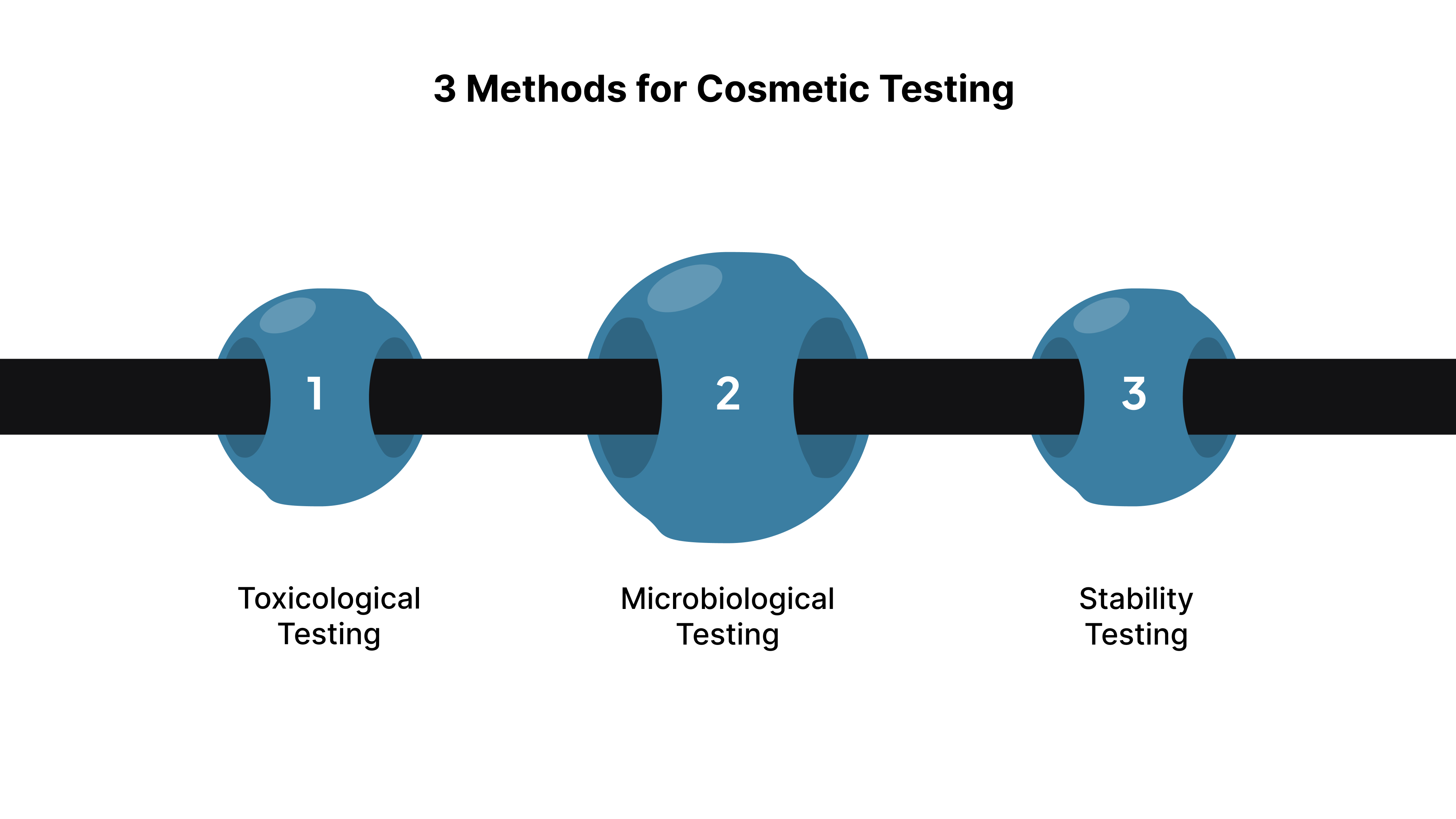
Method 1: Toxicological Testing (Ensures Ingredients Don’t Harm Human Health)
Toxicological testing helps brands verify that every ingredient and the final formulation are safe for real-world daily use. The goal is not just “is this product safe?” but “is this product safe for long-term, repeated exposure on human skin, eyes, and lips?”
What toxicological testing covers in cosmetics:
Skin and eye irritation
Allergic reactions (sensitisation)
Phototoxicity (reaction when exposed to sunlight)
Toxicity from repeated use
Interactions between two or more ingredients
How brands actually execute this testing
Stage | What Happens | Output |
|---|---|---|
1. Ingredient Safety Review | Toxicologist checks each ingredient against global safety databases (SDS, CosIng, CIR, IFRA) | Identifies risky ingredients or limits |
2. Final Formula Safety Assessment | Reviews concentration levels + interactions in full formulation | Determines if the blend is safe when combined |
3. Exposure Scenario Testing | Evaluates safety based on real-life use (face cream vs lipstick vs under-eye serum) | Confirms safe daily dose and usage frequency |
4. Human Repeat-Insult Patch Test (HRIPT) | Micro-dose tested on a small panel to check irritation and allergy risk | “Skin-Safe” / “Non-Irritating” / “Hypoallergenic” proofs |
Pass Criteria a product must meet
A formula is considered toxicologically safe only if:
It does not irritate or sensitize skin/eyes
It remains safe under sunlight exposure
It poses no cumulative toxicity risk
It meets global limits for restricted ingredients
Why this matters to businesses?
This testing:
Protects the brand from consumer injury claims
Enables regulatory approval in the US, EU, GCC, and Asia
Allows marketing claims (“Dermatologist Tested,” “Hypoallergenic,” “Safe for Sensitive Skin”)
Method 2: Microbiological Testing (Prevents Contamination and Protects Consumers From Infections)
Microbiological testing confirms that a cosmetic product does not allow the growth of harmful microorganisms either during manufacturing or throughout its shelf life. This testing is crucial for water-based formulas, products for the face, lips, and eyes, and anything applied by hand contact.
What microbiological testing checks for:
Harmful bacteria (e.g., Staphylococcus aureus, E. coli, Pseudomonas aeruginosa)
Yeast and mould contamination
Microbial growth after repeated user contact
Effectiveness of the preservative system
How brands actually execute this testing
Stage | What Happens | Output |
|---|---|---|
1. Total Microbial Count Test | Measures bacterial, yeast, and mould levels in the finished product | Confirms the product meets global microbial limits |
2. Pathogen Screening | Detects the presence of high-risk pathogens | Safety confirmation or rejection |
3. Preservative Challenge Test (PET) | Intentional contamination of the formula to test whether preservatives neutralise microbes | Pass/Fail for preservative system strength |
4. Packaging Interaction Study | Checks if packaging introduces microbes or weakens preservatives | Approves or rejects packaging for final use |
Pass Criteria: a product must meet:
A cosmetic product passes microbiological testing only if:
Total microbial count remains within regulatory limits
No harmful pathogens are detected
The preservative system successfully inhibits microbial growth
Packaging does not cause additional contamination
High-risk product categories requiring stricter testing
Creams and lotions with high water content
Lip balms and glosses (frequently applied by hand)
Eye products (highest sensitivity zone)
Baby skincare products
Anti-ageing serums with botanical extracts
Why this matters to businesses?
Solid microbiological safety protects brands from:
Consumer infection complaints
Product recalls
Social media backlash and reputation risk
Regulatory approval failure in the US, EU, GCC, and Asia
Method 3: Stability & Compatibility Testing (Ensures Performance, Shelf Life, and Packaging Safety)
Stability & compatibility testing verifies how a cosmetic product behaves over time; in different temperatures, climates, and packaging conditions. The aim is to ensure that the formula remains safe, effective, and visually consistent from production to expiry.
What stability & compatibility testing evaluates:
Shelf life (real-time & accelerated ageing)
Texture, viscosity, and colour changes
pH shift over time
Breakdown of active ingredients
Separation of oil and water phases
Fragrance and preservative degradation
Interaction with packaging materials
How brands actually execute this testing
Stage | What Happens | Output |
|---|---|---|
1. Accelerated Stability Test | Product stored in cycles of heat, cold, humidity & UV exposure | Predicts shelf life and expiry date |
2. Real-Time Stability Test | Product stored in typical storage conditions for 3–12 months | Confirms long-term performance and consistency |
3. Packaging Compatibility Test | Formula filled into actual packaging and monitored | Confirms no leakage, corrosion, swelling, absorption, or discoloration |
4. Freeze–Thaw Test | Product rapidly frozen and thawed several times | Detects early formulation instability or ingredient separation |
Pass Criteria: a product must meet:
A cosmetic product passes stability & compatibility testing only if:
No separation, crystallisation, or sedimentation occurs
Texture, colour, and fragrance remain unchanged
pH and viscosity stay within acceptable range
Actives retain their efficacy
Packaging does not deform, leak, corrode, or absorb product
Expiry date can be established confidently
High-risk formulas that require extended stability monitoring
Sunscreens (SPF degradation over time)
Vitamin C and retinol serums (highly unstable actives)
Botanical and water-rich formulations
Hair dyes and chemical treatments
Products exposed to heat (body butters, lip balms)
Why this matters to businesses?
Stability & compatibility testing helps brands:
Avoid expensive product recalls due to instability
Prevent consumer complaints like separation, bad smell, and texture change
Get approval from retailers and distributors
Establish marketing claims such as “12-month shelf life” or “SPF remains stable after 6 months.”
For product innovation managers and procurement leads overseeing new product launches, collaborating with FDA-certified labs safeguards the product’s safety and longevity on the market.
Next, let’s explore the role of natural ingredients in cosmetic products.
The Role of Natural Ingredients in Cosmetics
The beauty market is increasingly focused on natural and organic ingredients, with many brands advertising their products as safe because they are derived from nature. However, being natural does not guarantee safety. Manufacturers still need to perform appropriate testing to prove that natural ingredients are safe for use.
Potential Risks of Natural Ingredients: Some plant-based or organic ingredients may cause allergic reactions or skin irritation.
No Guarantee of Safety: Even “natural” ingredients can be harmful, requiring the same safety checks as synthetic ones.
For cosmetic startups and private-label brands using natural or organic ingredients, it’s essential to conduct testing to verify product safety, regardless of its origin.
Performing product testing for cosmetics and beauty products can be challenging, but Respect Manufacturing makes it simple. Our team ensures that your products are safe, effective, and fully compliant with all regulations.
Animal testing has been a topic of debate. Let’s discuss its importance and the alternatives available for testing cosmetic safety.
Importance of Animal Testing in Cosmetics
While animal testing has been historically used to determine the safety of cosmetics, there are now alternatives that allow manufacturers to meet safety requirements without testing on animals. The FDA permits animal testing but does not require it, encouraging the use of more ethical alternatives.
Some alternative testing methods include:
In Vitro Testing: Uses cultured cells to test the toxicity of cosmetic products without the need for animals.
Computer Simulations: Advanced technology can predict how a product will interact with the human body.
Human Volunteer Testing: Some brands use human volunteers under controlled conditions to test product safety.
For cruelty-free cosmetic brands, adopting non-animal testing methods aligns with ethical values and positions the brand as more in tune with modern consumer demands.
Microbiological safety is crucial to prevent contamination. Here’s how cosmetic manufacturers ensure products remain safe for consumer use.
Maintaining Microbiological Safety in Cosmetic Product Testing
Cosmetic products must be free of harmful microorganisms to guarantee consumer safety. While cosmetics don’t need to be sterile, they must have low levels of aerobic microorganisms.
Here are some key considerations for microbiological safety:
Packaging: Cosmetic packaging must prevent contamination, especially for products that require consumers to dip their fingers (e.g., creams).
Preservatives: Many cosmetic formulations require preservatives to keep products free of harmful bacteria and fungi.
For private-label entrepreneurs scaling their cosmetic lines, it’s crucial to work with manufacturers who understand microbiological testing and ensure that all products are safe from contamination.
Finally, let’s see how Respect Manufacturing approaches cosmetic product testing, offering the highest standards of safety and compliance for your beauty products.
Respect Manufacturing's Approach to Product Testing for Cosmetics and Beauty Products
As cosmetic and beauty brands scale, achieving FDA compliance through rigorous product testing becomes more complex. From toxicological assessments to stability testing, manufacturers must meet high standards while managing tight timelines. Without proper oversight, these challenges can result in costly delays and non-compliance.
Respect Manufacturing provides the solution, offering a comprehensive testing and production process that ensures that your cosmetics and beauty products meet all FDA regulations. Here’s how Respect Manufacturing ensures every testing step meets the highest safety and compliance standards.
FDA-Registered & CGMP-Compliant Facility: Manufactured in an FDA-registered facility with stainless steel automated lines, Respect Manufacturing adheres to CGMP standards, maintaining quality and compliance at every stage of production.
Thorough Testing and Quality Assurance: AQL testing is applied to all incoming raw materials, packaging, and finished goods. Stability testing helps formulations maintain performance and shelf life under various conditions.
R&D and Formulation Expertise: Offering formulation development for new and refined products, Respect Manufacturing works collaboratively to make sure that your products meet regulatory, market, and performance standards.
Diverse Manufacturing and Packaging Options: The facility supports a wide range of packaging formats (bottles, jars, tubes, sachets), while also managing primary and secondary packaging, including labels, boxes, and component quality checks.
Turnkey Solutions: From concept to finished goods, Respect Manufacturing offers end-to-end services including formulation, stability testing, manufacturing, packaging, and logistics, creating a seamless, compliant production process.
By partnering with Respect Manufacturing, you can tackle the complexities of cosmetic testing with confidence, so your products are safe, compliant, and market-ready.
Conclusion
To test cosmetics for safety and verify compliance with FDA guidelines, manufacturers must rely on a combination of safety data, in-depth testing, and rigorous quality control measures. Product testing, whether toxicological, microbiological, or for stability, confirms that cosmetic products meet safety standards and are suitable for consumer use.
With increasing demand for safe and ethical cosmetics, manufacturers must stay ahead by using advanced testing methods and adhering to FDA requirements.
Respect Manufacturing simplifies the complexities of product testing to ensure your cosmetics are safe, effective, and fully compliant with FDA regulations. Our expert team executes thorough quality control and testing at every stage of production.
Contact Respect Manufacturing today to learn how we can help your brand meet the highest standards in cosmetic safety and compliance.
FAQs
What types of product testing are required for cosmetics and beauty products?
Cosmetics must undergo toxicological testing to identify potential allergens or irritants, microbiological testing to ensure the absence of harmful bacteria, and stability testing to assess shelf life and product performance. These tests help verify that the products meet FDA regulations and ensure consumer safety and effectiveness.
Can my cosmetic products be sold without FDA approval?
The FDA does not require pre-market approval for most cosmetics, but manufacturers must ensure their products are safe before going to market. This includes ensuring compliance with labeling, packaging, and ingredient safety standards. If products are found to be unsafe, the FDA can take enforcement action.
How can I be sure my cosmetic product is safe for consumers?
To ensure safety, manufacturers should conduct toxicological and microbiological tests and review safety data for each ingredient used. Following CGMP (Current Good Manufacturing Practices) guidelines also helps guarantee that the product is safe for use and meets FDA regulations.
Do I need animal testing to meet cosmetic safety standards?
The FDA does not require animal testing for most cosmetic products, but it may be used in some cases. Non-animal testing methods, such as in vitro testing and computer simulations, are widely accepted and can provide reliable safety data without using animals, aligning with ethical standards.
What happens if my cosmetic product is found to be unsafe after it hits the market?
If a product is found to be unsafe, the FDA can issue warning letters, mandate product recalls, or impose fines on manufacturers. These actions can severely damage a brand’s reputation and lead to significant financial and legal consequences, highlighting the importance of thorough testing and compliance.